Skip to main content
Calculus
Il mio corso
Impara
Preparazione agli esami
AI Tutor
Guide di studio
Soluzioni per libri di testo
Flashcard
Esplora
Prova l'app
Il mio corso
Impara
Preparazione agli esami
AI Tutor
Guide di studio
Soluzioni per libri di testo
Flashcard
Esplora
Prova l'app
Indietro
Parametric Equations quiz
Puoi toccare per girare la carta.
What is a parametric equation?
Puoi toccare per girare la carta.
👆
What is a parametric equation?
A parametric equation expresses x and y in terms of a third variable, usually called t, the parameter.
Avanzamenti del tracciato
I pulsanti di controllo sono stati cambiati in modalità "navigazione".
1/15
Flashcard correlate
Pratica correlata
Video consigliati
Parametric Equations definitions
Parametric Equations
15 Termini
Parametric Equations
16. Parametric Equations & Polar Coordinates
5 Problemi
Argomento
Ernest
Calculus with Parametric Curves
16. Parametric Equations & Polar Coordinates
5 Problemi
Argomento
16. Parametric Equations & Polar Coordinates
5 Argomenti
14 Problemi
Capitolo
Justin
08:02
Parameterizing Equations
335
views
5
rank
04:11
Eliminate Parameter: Equations with Trig
329
views
10
rank
04:39
Eliminate Parameter: Equations with Trig Example 3
282
views
9
rank
Termini in questo insieme (15)
Nascondere definizioni
What is a parametric equation?
A parametric equation expresses x and y in terms of a third variable, usually called t, the parameter.
How do you graph parametric equations?
Create a table of values for t, x(t), and y(t), then plot the corresponding (x, y) points on the plane.
What is the main difference between parametric equations and standard two-variable equations?
Parametric equations involve two equations for x and y in terms of t, while standard equations relate y directly to x.
What is a 'plane curve' in the context of parametric equations?
A plane curve is the graph of parametric equations, which can be a line, parabola, or other shapes.
How is the direction or orientation of a parametric curve indicated?
The direction is shown with arrows along the curve, indicating increasing t values.
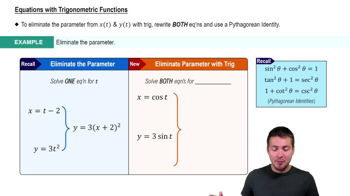
What does 'eliminating the parameter' mean?
It means removing t from the equations to obtain a single equation involving only x and y.
What is the typical process for eliminating the parameter?
Solve one equation for t and substitute it into the other equation to get a rectangular equation.
Why might you only get part of a curve when graphing parametric equations?
Domain restrictions on t can limit the portion of the curve represented by the parametric equations.
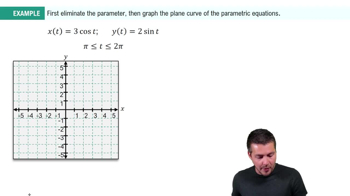
How do you eliminate the parameter in parametric equations involving trigonometric functions?
Solve for the trig functions in terms of x and y, then use a Pythagorean identity to relate them and eliminate t.
What Pythagorean identity is commonly used to eliminate the parameter in trig-based parametric equations?
The identity sin²(t) + cos²(t) = 1 is used to relate sine and cosine terms.
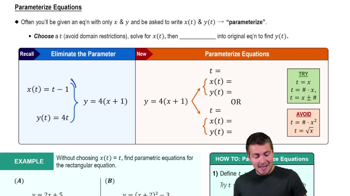
How do you parameterize a rectangular equation?
Choose a simple expression for t, solve for x(t), and substitute into the original equation to find y(t).
What should you avoid when choosing t for parameterization?
Avoid expressions that introduce domain restrictions, such as even powers or square roots of x.
How can you check if your parameterization is correct?
Eliminate the parameter from your parametric equations; you should recover the original rectangular equation.
How do you parameterize equations of circles or ellipses?
Rewrite the equation in the form f(x)² + g(y)² = 1, then set f(x) = cos(t) and g(y) = sin(t), solving for x(t) and y(t).
What is the result of eliminating the parameter from x = cos(t), y = 3sin(t)?
You get x² + (y/3)² = 1, which is the equation of an ellipse.
 IndietroIndietro
 08:02
08:02