Skip to main content
Calculus
Il mio corso
Impara
Preparazione agli esami
AI Tutor
Guide di studio
Soluzioni per libri di testo
Flashcard
Esplora
Prova l'app
Il mio corso
Impara
Preparazione agli esami
AI Tutor
Guide di studio
Soluzioni per libri di testo
Flashcard
Esplora
Prova l'app
Indietro
Polar Coordinates quiz
Puoi toccare per girare la carta.
What are the two components of a point in polar coordinates?
Puoi toccare per girare la carta.
👆
What are the two components of a point in polar coordinates?
A point in polar coordinates is given by (r, θ), where r is the distance from the pole and θ is the angle from the polar axis.
Avanzamenti del tracciato
I pulsanti di controllo sono stati cambiati in modalità "navigazione".
1/15
Flashcard correlate
Pratica correlata
Video consigliati
Polar Coordinates definitions
Polar Coordinates
15 Termini
Polar Coordinates
16. Parametric Equations & Polar Coordinates
5 Problemi
Argomento
Ernest
Calculus in Polar Coordinates
16. Parametric Equations & Polar Coordinates
5 Problemi
Argomento
Ernest
16. Parametric Equations & Polar Coordinates
5 Argomenti
14 Problemi
Capitolo
Justin
06:17
Convert Points from Polar to Rectangular
242
views
5
rank
2:21
Convert Points from Rectangular to Polar Example 1
211
views
6
rank
3:03
Convert Equations from Polar to Rectangular Example 2
196
views
2
rank
Termini in questo insieme (15)
Nascondere definizioni
What are the two components of a point in polar coordinates?
A point in polar coordinates is given by (r, θ), where r is the distance from the pole and θ is the angle from the polar axis.
How do you plot a point with a negative r value in polar coordinates?
Plot the angle θ first, then move |r| units in the direction opposite to θ.
What is the relationship between coterminal angles and polar coordinates?
Coterminal angles represent the same direction, so adding or subtracting multiples of 2π to θ gives different ordered pairs for the same point.
How do you find another polar coordinate for the same point if you change r to negative?
Change r to -r and add π to θ, then you can also add or subtract multiples of 2π to θ.
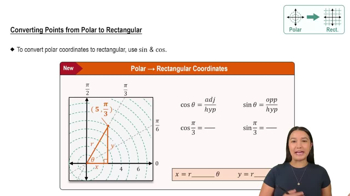
What are the formulas to convert from polar to rectangular coordinates?
x = r cos(θ) and y = r sin(θ).
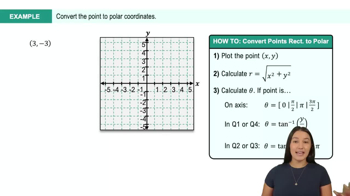
How do you convert the rectangular point (x, y) to polar coordinates?
r = sqrt(x^2 + y^2) and θ = arctan(y/x), adjusting θ based on the quadrant.
What is the rectangular coordinate of the polar point (0, θ)?
It is always (0, 0), regardless of θ.
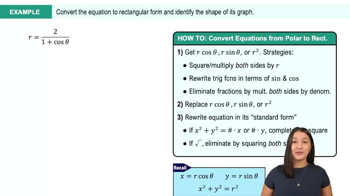
What is the polar form of the equation x^2 + y^2 = 25?
The polar form is r^2 = 25.
How do you convert the rectangular equation y = 5 to polar form?
Replace y with r sin(θ) to get r sin(θ) = 5, or r = 5 csc(θ).
What is the rectangular form of the polar equation r = 4?
It is x^2 + y^2 = 16, which is a circle of radius 4.
How do you recognize the equation of a cardioid in polar coordinates?
A cardioid has the form r = a ± a cos(θ) or r = a ± a sin(θ), where the coefficients are equal.
What is the general form of a rose curve in polar coordinates and how do you determine the number of petals?
The form is r = a cos(nθ) or r = a sin(nθ); if n is even, there are 2n petals, if n is odd, there are n petals.
How do you identify a lemniscate from its polar equation?
A lemniscate has the form r^2 = a^2 cos(2θ) or r^2 = a^2 sin(2θ), and is the only common polar shape with r squared.
What symmetry does the graph of r = 1 + cos(θ) have?
It is symmetric about the polar axis (the line θ = 0).
When graphing a limacon r = a ± b sin(θ), how do you know if it has a dimple or an inner loop?
If a > b, the limacon has a dimple; if a < b, it has an inner loop.
 IndietroIndietro
 06:17
06:17