Skip to main content
Calculus
Il mio corso
Impara
Preparazione agli esami
AI Tutor
Guide di studio
Soluzioni per libri di testo
Flashcard
Esplora
Prova l'app
Il mio corso
Impara
Preparazione agli esami
AI Tutor
Guide di studio
Soluzioni per libri di testo
Flashcard
Esplora
Prova l'app
Indietro
Related Rates quiz
Puoi toccare per girare la carta.
What is the first step in solving a related rates problem?
Puoi toccare per girare la carta.
👆
What is the first step in solving a related rates problem?
The first step is to take the time derivative of both sides of the equation, using implicit differentiation.
Avanzamenti del tracciato
I pulsanti di controllo sono stati cambiati in modalità "navigazione".
1/15
Flashcard correlate
Pratica correlata
Video consigliati
Related Rates definitions
Related Rates
15 Termini
Related Rates
4. Applications of Derivatives
3 Problemi
Argomento
Ernest
Linearization
4. Applications of Derivatives
3 Problemi
Argomento
Jonathan
4. Applications of Derivatives
5 Argomenti
10 Problemi
Capitolo
Justin
VideoThumbView.guidedCourse
04:16
Intro To Related Rates
2320
views
58
rank
VideoThumbView.guidedCourse
06:16
Real World Application
1147
views
14
rank
1
comments
VideoThumbView.guidedCourse
06:35
Changing Geometries
1606
views
44
rank
Termini in questo insieme (15)
Nascondere definizioni
What is the first step in solving a related rates problem?
The first step is to take the time derivative of both sides of the equation, using implicit differentiation.
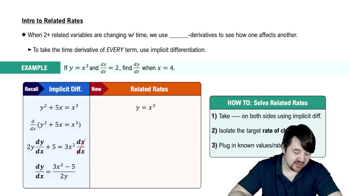
When differentiating y = x^3 with respect to time, what is dy/dt in terms of x and dx/dt?
dy/dt = 3x^2 dx/dt.
Why do we use the chain rule in related rates problems?
We use the chain rule because variables are functions of time, so we must account for how each variable changes with respect to time.
In a related rates problem, what does a negative rate indicate about the variable?
A negative rate indicates that the variable is decreasing over time, such as a shrinking side length or volume.
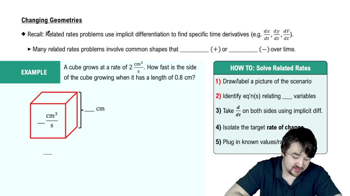
If a cube's volume is increasing at 2 cm^3/sec, what is the sign of dV/dt?
dV/dt is positive because the volume is increasing.
What equation relates the volume V of a cube to its side length x?
The equation is V = x^3.
How do you find the rate at which the side of a cube is growing if you know dV/dt and x?
Use the formula dx/dt = (dV/dt) / (3x^2).
What should you do if the related rates problem does not provide an explicit equation?
Identify the variables and relationships, then determine the appropriate equation that relates them, often based on geometry.
Why is it important to label diagrams in related rates problems?
Labeling diagrams helps clarify which variables are changing and how they relate to each other, making it easier to set up equations.
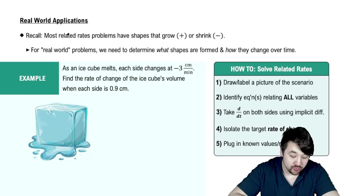
If an ice cube melts and each side shrinks at -3 cm/min, what is dx/dt?
dx/dt is -3 cm/min.
How do you interpret a negative value for dV/dt in a melting ice cube problem?
A negative dV/dt means the volume is decreasing, which matches the physical situation of melting.
What is the general process for solving a related rates problem?
Take time derivatives, isolate the target rate, plug in known values, and solve for the unknown rate.
When is it necessary to use implicit differentiation in related rates?
Implicit differentiation is necessary when variables are related and both change with respect to time.
What units should you use for dx/dt if x is measured in centimeters and t in seconds?
The units for dx/dt should be centimeters per second (cm/s).
If you are given the rate of change of one variable and need the rate of another, what must you ensure about your equation?
You must ensure your equation relates all relevant variables and their rates of change with respect to time.
 IndietroIndietro
 04:16
04:16