Skip to main content
Calculus
Il mio corso
Impara
Preparazione agli esami
AI Tutor
Guide di studio
Soluzioni per libri di testo
Flashcard
Esplora
Prova l'app
Il mio corso
Impara
Preparazione agli esami
AI Tutor
Guide di studio
Soluzioni per libri di testo
Flashcard
Esplora
Prova l'app
Indietro
Trigonometric Identities quiz
Puoi toccare per girare la carta.
What are the three criteria for a fully simplified trigonometric expression?
Puoi toccare per girare la carta.
👆
What are the three criteria for a fully simplified trigonometric expression?
All arguments must be positive, the expression should contain no fractions, and it should have as few trig functions as possible.
Avanzamenti del tracciato
I pulsanti di controllo sono stati cambiati in modalità "navigazione".
1/15
Flashcard correlate
Pratica correlata
Video consigliati
Trigonometric Identities definitions
Trigonometric Identities
15 Termini
Trigonometric Identities
0. Functions
2 Problemi
Argomento
Inverse Trigonometric Functions
0. Functions
3 Problemi
Argomento
Jonathan
0. Functions - Part 1 of 2
7 Argomenti
14 Problemi
Capitolo
Patrick
0. Functions - Part 2 of 2
8 Argomenti
12 Problemi
Capitolo
David-Paige
7:17
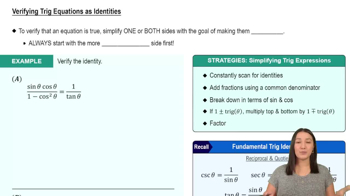
Verifying Trig Equations as Identities
900
views
8
rank
6:36
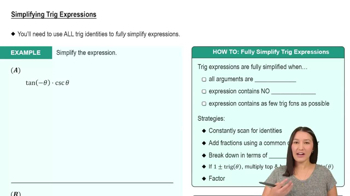
Simplifying Trig Expressions
1534
views
12
rank
5:18
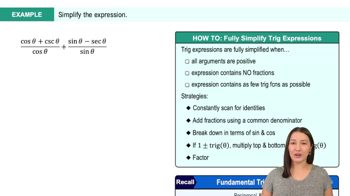
Simplifying Trig Expressions Example 2
974
views
9
rank
1
comments
Termini in questo insieme (15)
Nascondere definizioni
What are the three criteria for a fully simplified trigonometric expression?
All arguments must be positive, the expression should contain no fractions, and it should have as few trig functions as possible.
Which identity allows you to rewrite tan(-θ) as a function of tan(θ)?
The even-odd identity states that tan(-θ) = -tan(θ).
How do you convert tangent and cosecant to sine and cosine?
Tangent is sine over cosine (tan(θ) = sin(θ)/cos(θ)), and cosecant is 1 over sine (csc(θ) = 1/sin(θ)).
What is the simplified form of tan(-θ) * csc(θ)?
It simplifies to -sec(θ) by applying identities and reducing to a single trig function.
What strategy should you use when you see 1 plus or minus a trig function in a fraction's denominator?
Multiply both the numerator and denominator by 1 minus or plus that same trig function to use the difference of squares.
How does sin²(θ) / (1 + cos(θ)) simplify?
It simplifies to 1 - cos(θ) by multiplying by (1 - cos(θ)) and using the Pythagorean identity.
What is the Pythagorean identity involving sine and cosine?
sin²(θ) + cos²(θ) = 1.
What is the process for verifying a trigonometric identity?
Simplify one or both sides of the equation using identities until both sides are equal.
How do you simplify sin(θ) * cos(θ) / (1 - cos²(θ))?
Replace 1 - cos²(θ) with sin²(θ), then simplify to cot(θ) or 1/tan(θ).
What identity relates sec²(θ) and tan²(θ)?
tan²(θ) + 1 = sec²(θ), so sec²(θ) - tan²(θ) = 1.
How do you handle cosine of a negative angle, cos(-θ)?
Cosine is an even function, so cos(-θ) = cos(θ).
What is the result of simplifying sec²(θ) - tan²(θ) / (cos(-θ) + 1)?
It simplifies to 1 / (cos(θ) + 1) by using identities and even-odd properties.
What should you do if you get stuck while simplifying or verifying a trig identity?
Start over from scratch, as a new approach may reveal a solution.
How do you solve sec²(θ) - 1 / tan(θ) = 1?
Rewrite sec²(θ) - 1 as tan²(θ), simplify to tan(θ) = 1, and solve for θ using the unit circle.
How do you use the double angle identity to simplify sin(2θ) / cos(-θ) = 1?
Rewrite sin(2θ) as 2sin(θ)cos(θ), use cos(-θ) = cos(θ), cancel cos(θ), and solve 2sin(θ) = 1 for θ.
 IndietroIndietro

 7:17
7:17