 Indietro
Calculus: Limits
 03:33
03:33
Termini in questo insieme (19)
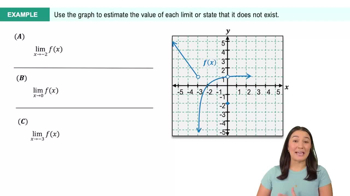
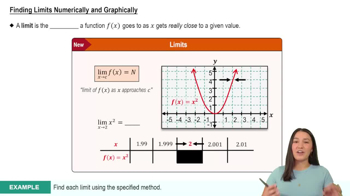
The limit of a function \(f(x)\) as \(x\) approaches a value \(a\) is the value that \(f(x)\) gets closer to as \(x\) approaches \(a\).
The limit of \(f(x)\) as \(x\) approaches \(a\) is written as \(\lim_{x \to a} f(x)\).
What does it mean if \(\lim_{x \to a} f(x) = L\)?
It means that as \(x\) gets arbitrarily close to \(a\), the function values \(f(x)\) approach the number \(L\).
A one-sided limit considers the behavior of \(f(x)\) as \(x\) approaches \(a\) from only one side: left (\(x \to a^-\)) or right (\(x \to a^+\)).
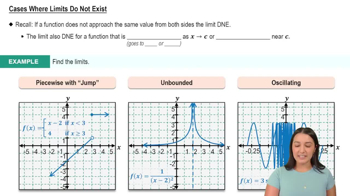
The limit exists if and only if the left-hand limit and right-hand limit at \(a\) are equal.
The limit is the constant itself: \(\lim_{x \to a} c = c\).
For polynomials, the limit is found by direct substitution: \(\lim_{x \to a} P(x) = P(a)\).
An indeterminate form occurs when substitution gives expressions like \(\frac{0}{0}\) or \(\infty - \infty\), requiring further analysis.
The limit is \(+\infty\) because values become very large positive numbers.
The limit is \(-\infty\) because values become very large negative numbers.
If \(g(x) \leq f(x) \leq h(x)\) near \(a\) and \(\lim_{x \to a} g(x) = \lim_{x \to a} h(x) = L\), then \(\lim_{x \to a} f(x) = L\).
Analyze the dominant terms in numerator and denominator to determine if the limit approaches \(\infty\), \(-\infty\), or a finite value.
The limit is \(0\) because the denominator grows without bound.
Continuity at \(a\) means \(\lim_{x \to a} f(x) = f(a)\). Limits describe behavior near \(a\), continuity requires the function value to match the limit.
For every \(\varepsilon > 0\), there exists \(\delta > 0\) such that if \(0 < |x - a| < \delta\), then \(|f(x) - L| < \varepsilon\).
A point where the limit exists but the function is not defined or differs from the limit value.
Derivatives are defined as limits of the difference quotient: \(f'(a) = \lim_{h \to 0} \frac{f(a+h) - f(a)}{h}\).
The limit is \(1\).
The limit is the number \(e\), approximately 2.718.