Skip to main content
Calculus
Il mio corso
Impara
Preparazione agli esami
AI Tutor
Guide di studio
Soluzioni per libri di testo
Flashcard
Esplora
Prova l'app
Il mio corso
Impara
Preparazione agli esami
AI Tutor
Guide di studio
Soluzioni per libri di testo
Flashcard
Esplora
Prova l'app
Indietro
Calculus: Limits and Continuity
Puoi toccare per girare la carta.
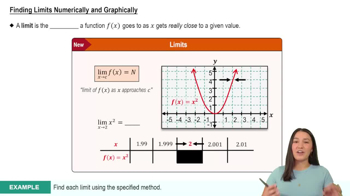
What is a limit of a function?
Puoi toccare per girare la carta.
👆
What is a limit of a function?
A
limit
is the value a function
f(x)
approaches as
x
gets really close to a given value.
Avanzamenti del tracciato
I pulsanti di controllo sono stati cambiati in modalità "navigazione".
1/20
Video consigliati
03:33
Cases Where Limits Do Not Exist Example 2
3057
views
83
rank
6:47
Finding Limits Numerically and Graphically
9369
views
344
rank
3
comments
03:07
Cases Where Limits Do Not Exist
3377
views
80
rank
1
comments
Termini in questo insieme (20)
Nascondere definizioni
What is a limit of a function?
A
limit
is the value a function
f(x)
approaches as
x
gets really close to a given value.
How can limits be found numerically?
By creating a
table of values
for
x
values approaching the target point from both sides and observing the function values.
What is the graphical interpretation of a limit?
The limit is the value that the function values approach on the graph as
x
approaches a specific point from both sides.
Does the limit always equal the function value at that point?
No, the limit may not be equal to the function value
f(c)
at the point
c
.
What is a one-sided limit?
A
one-sided limit
is the limit of a function as
x
approaches a point from only the left or only the right side.
How is the left-hand limit denoted?
The left-hand limit is written as \(\lim_{x \to c^-} f(x)\).
How is the right-hand limit denoted?
The right-hand limit is written as \(\lim_{x \to c^+} f(x)\).
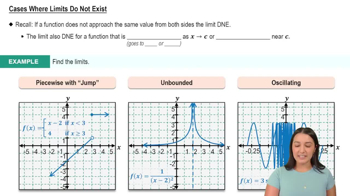
When does a limit not exist (DNE)?
If the left-hand and right-hand limits are not equal, the limit does not exist.
What is the direct substitution method for finding limits?
For many functions like polynomials, the limit as
x
approaches
c
is simply
f(c)
, found by substituting
c
into the function.
How to find limits of rational functions when denominator ≠ 0?
The limit equals the function value at that point, found by direct substitution.
How to find limits of rational functions when denominator = 0?
If numerator and denominator both zero, factor and simplify to cancel common factors, then substitute.
What is the conjugate method for limits involving radicals?
Multiply numerator and denominator by the conjugate to eliminate radicals, then simplify and evaluate the limit.
What are discontinuities in a function?
Points where the function has a jump, hole, or vertical asymptote, causing the function to be not continuous.
How to determine continuity algebraically?
Check if the limit exists at a point and equals the function value at that point.
What is the difference between limit and function value at a point?
The limit describes behavior as
x
approaches a point, while the function value is the actual value at that point.
What is the significance of one-sided limits in continuity?
A function is continuous at a point only if both one-sided limits exist and are equal to the function value.
How to use a graph to estimate limits?
Observe the y-values the function approaches as
x
approaches the target from left and right.
What is the limit notation for approaching from the left?
Use \(\lim_{x \to c^-} f(x)\) to denote approaching
c
from the left.
What is the limit notation for approaching from the right?
Use \(\lim_{x \to c^+} f(x)\) to denote approaching
c
from the right.
What happens if the left and right limits differ?
The overall limit at that point does not exist (DNE).
 IndietroIndietro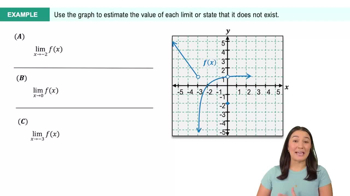
 03:33
03:33