 Indietro
Calculus: Limits
 03:33
03:33
Termini in questo insieme (20)
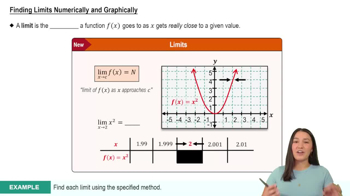
The limit of a function \(f(x)\) as \(x\) approaches a value \(a\) is the value that \(f(x)\) gets closer to as \(x\) approaches \(a\).
The limit of \(f(x)\) as \(x\) approaches \(a\) is written as \(\lim_{x \to a} f(x)\).
It means that as \(x\) gets arbitrarily close to \(a\), the function values \(f(x)\) approach the number \(L\).
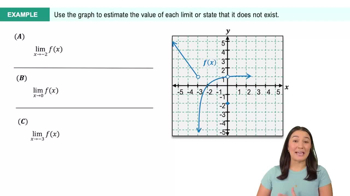
A one-sided limit considers the behavior of \(f(x)\) as \(x\) approaches \(a\) from only one side: left (\(x \to a^-\)) or right (\(x \to a^+\)).
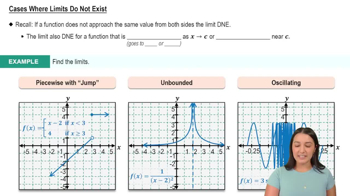
The limit exists if and only if the left-hand limit and right-hand limit at \(a\) are equal.
The limit is the constant itself: \(\lim_{x \to a} c = c\).
For polynomials, the limit is the value of the polynomial evaluated at \(a\): \(\lim_{x \to a} P(x) = P(a)\).
The limit is positive infinity because values approach very large positive numbers.
The limit is negative infinity because values approach very large negative numbers.
An indeterminate form occurs when direct substitution results in expressions like \(\frac{0}{0}\) or \(\infty - \infty\), requiring further analysis.
If \(f(x) \leq g(x) \leq h(x)\) near \(a\) and \(\lim_{x \to a} f(x) = \lim_{x \to a} h(x) = L\), then \(\lim_{x \to a} g(x) = L\).
Analyze the dominant terms in numerator and denominator to determine if the limit approaches infinity, zero, or a finite number.
The limit is infinity because values become very large positive numbers from both sides.
Continuity at a point means the limit exists and equals the function value; limits alone describe approaching behavior.
For every \(\varepsilon > 0\), there exists \(\delta > 0\) such that if \(0 < |x - a| < \delta\), then \(|f(x) - L| < \varepsilon\).
A point where the limit exists but the function is not defined or differs from the limit value.
The derivative is defined as \(f'(a) = \lim_{h \to 0} \frac{f(a+h) - f(a)}{h}\).
The limit is 1.
The limit is the number e, approximately 2.718.
The limit is 0, found by rationalizing the expression.