 Indietro
Calculus I: Limits, Continuity, and the Definition of the Derivative
Guida di studio - Note intelligenti
 Appunti personalizzati basati sui tuoi materiali, ampliati con definizioni chiave, esempi e contesto.
Limits and Continuity
Definition of a Limit
The limit of a function as x approaches a value describes the behavior of the function near that value, not necessarily at the value itself.
Notation: means as x approaches a, f(x) approaches L.
One-sided limits: (from the left), (from the right).
Existence: The limit exists if and only if both one-sided limits exist and are equal.
Evaluating Limits
Direct substitution: If is defined and continuous, .
Factoring and simplifying: Used when direct substitution yields an indeterminate form (e.g., ).
Special limits: and .
Continuity
A function is continuous at if:
is defined
exists
Types of Discontinuities
Removable discontinuity: The limit exists, but is not defined or not equal to the limit.
Jump discontinuity: The left and right limits exist but are not equal.
Infinite discontinuity: The function approaches infinity near .
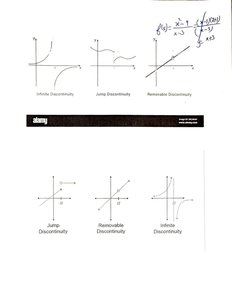
Piecewise Functions and Continuity
For piecewise functions, check continuity at the points where the formula changes by evaluating left and right limits and the function value.
Example:
Check , , and .
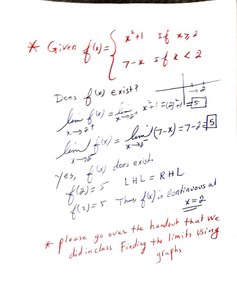
Definition of the Derivative
Derivative as a Limit
The derivative of a function at a point gives the slope of the tangent line to the curve at that point. It is defined as:
Alternatively,
The derivative represents the instantaneous rate of change of the function at a point.
Finding the Equation of the Tangent Line
Find using the definition of the derivative.
Use the point-slope form:
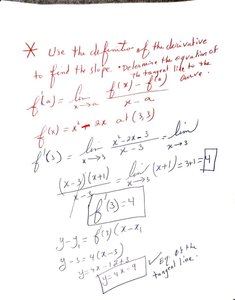
Techniques for Evaluating Limits
Algebraic Manipulation
Factor numerator and denominator to cancel common terms.
Rationalize numerator or denominator if radicals are present.
Special Cases and Indeterminate Forms
Indeterminate forms include and .
Apply algebraic techniques or L'Hôpital's Rule (if covered).
Examples
: Factor numerator to get , cancel , and substitute to get $6$.
: Multiply numerator and denominator by the conjugate to simplify.
Squeeze (Sandwich) Theorem
Statement of the Theorem
If for all near (except possibly at $a$), and , then .
Used to evaluate limits of functions that are difficult to compute directly.
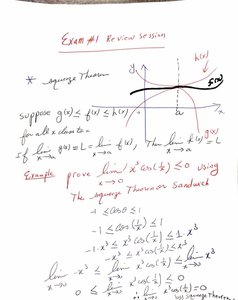
Graphical Analysis of Limits and Continuity
Using Graphs to Find Limits
Observe the behavior of the function as approaches a value from both sides.
Identify discontinuities and classify them as removable, jump, or infinite.
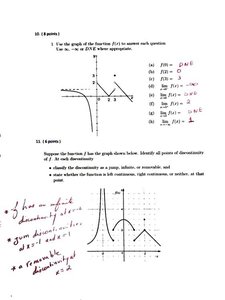
Practice Problems and Solutions
Evaluating Limits Analytically
Practice with rational, radical, and piecewise functions.
Check for continuity and differentiability at given points.
Determining Continuity for All Values
Find values of parameters that make piecewise functions continuous everywhere.
Summary Table: Types of Discontinuities
Type | Description | Graphical Feature |
|---|---|---|
Removable | Limit exists, function value missing or different | Hole in the graph |
Jump | Left and right limits not equal | Sudden jump in graph |
Infinite | Function approaches infinity | Vertical asymptote |
Additional info: These notes cover foundational concepts in Calculus I, including limits, continuity, the definition of the derivative, and the Squeeze Theorem, with examples and graphical interpretations to reinforce understanding.
