Ch. 1 - Functions
Briggs - Calculus: Early Transcendentals 3rd Edition
Briggs3rd EditionCalculus: Early TranscendentalsISBN: 9780136847243Non è quello che usi tu?Cambia libro di testo
Capitolo 1, Problema 19b

Composite functions
Let ƒ(x) = x³, g (x) = sin x and h(x) = √x .
Find h (ƒ (x)).

Guida verificata passo dopo passo
1
Step 1: Understand the problem. We are asked to find the composite function h(ƒ(x)), which means we need to substitute ƒ(x) into h(x).
Step 2: Identify the given functions. We have ƒ(x) = x^3 and h(x) = \(\sqrt{x}\).
Step 3: Substitute ƒ(x) into h(x). This means replacing the x in h(x) with ƒ(x).
Step 4: Write the expression for the composite function. h(ƒ(x)) becomes h(x^3).
Step 5: Simplify the expression. Since h(x) = \(\sqrt{x}\), h(x^3) becomes \(\sqrt{x^3}\).

Risposta video verificata per un problema simile:

Questa soluzione video è stata consigliata dai nostri tutor come utile per risolvere questo problema.
Durata del video:
3m

Concetti chiave

Ecco i concetti essenziali che devi comprendere per rispondere correttamente alla domanda.

Composite Functions

A composite function is formed when one function is applied to the result of another function. It is denoted as (f ∘ g)(x) = f(g(x)). Understanding how to combine functions is essential for evaluating expressions like h(f(x)), where the output of f(x) becomes the input for h.
Video consigliato:
3:48
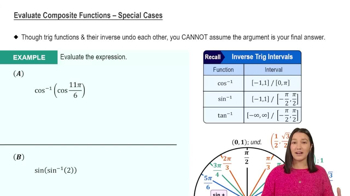
Evaluate Composite Functions - Special Cases

Function Notation

Function notation is a way to represent functions and their operations clearly. For example, f(x) represents the output of function f when x is the input. Recognizing how to read and interpret function notation is crucial for correctly applying functions in composite scenarios.
Video consigliato:
Percorso guidato
7:24
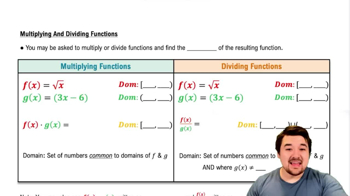
Multiplying & Dividing Functions

Basic Functions and Their Properties

Familiarity with basic functions, such as polynomial functions (like f(x) = x³), trigonometric functions (like g(x) = sin x), and radical functions (like h(x) = √x), is vital. Each function has unique properties that affect how they interact in compositions, influencing the overall behavior of the composite function.
Video consigliato:
Percorso guidato
06:21
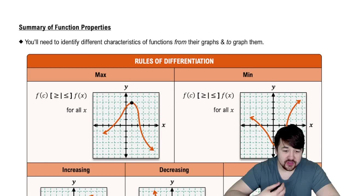
Properties of Functions
Pratica correlata
Domanda del libro di testo

Composite functions

Let ƒ(x) = x³, g (x) = sin x and h(x) = √x .

Evaluate h(g( π/2)).

356
views

Domanda del libro di testo

Evaluating trigonometric functions Without using a calculator, evaluate the following expressions or state that the quantity is undefined.


cos (2π/3)

267
views
Domanda del libro di testo

Composite functions

Let ƒ(x) = x³, g (x) = sin x and h(x) = √x.

Find the domain of g o ƒ.

355
views
Domanda del libro di testo

Composite functions

Let ƒ(x) = x³, g (x) = sin x and h(x) = √x.

Find ƒ(g(h( x))).

363
views
Domanda del libro di testo

Yeast growth Consider a colony of yeast cells that has the shape of a cylinder. As the number of yeast cells increases, the cross-sectional area A (in mm²) of the colony increases but the height of the colony remains constant. If the colony starts from a single cell, the number of yeast cells (in millions) is approximated by the linear function N(A) - CₛA, where the constant Cₛ is known as the cell-surface coefficient. Use the given information to determine the cell-surface coefficient for each of the following colonies of yeast cells, and find the number of yeast cells in the colony when the cross-sectional area A reaches 150 mm². (Source: Letters in Applied Microbiology, 594, 59, 2014)

The scientific name of baker’s or brewer’s yeast (used in making bread, wine, and beer) is Saccharomyces cerevisiae. When the cross-sectional area of a colony of this yeast reaches 100 mm², there are 571 million yeast cells.

236
views