Ch. 1 - Functions
Briggs - Calculus: Early Transcendentals 3rd Edition
Briggs3rd EditionCalculus: Early TranscendentalsISBN: 9780136847243Non è quello che usi tu?Cambia libro di testo
Capitolo 1, Problema 77c

Determine whether the following statements are true and give an explanation or counterexample.
log546=4log56\(\log\)_54^6=4\(\log\)_56

Guida verificata passo dopo passo
1
Step 1: Start by applying the power rule of logarithms to the left side of the equation. The power rule states that \( \log_b(a^n) = n \cdot \log_b(a) \). Therefore, \( \log_5(4^6) = 6 \cdot \log_5(4) \).
Step 2: Now, rewrite the right side of the equation, which is \( 4 \cdot \log_5(6) \).
Step 3: Compare the expressions from Step 1 and Step 2. We have \( 6 \cdot \log_5(4) \) on the left and \( 4 \cdot \log_5(6) \) on the right.
Step 4: For the original statement to be true, \( 6 \cdot \log_5(4) \) must equal \( 4 \cdot \log_5(6) \).
Step 5: Consider whether there is a known relationship or property that equates these two expressions, or if a counterexample can be found by evaluating the expressions numerically.

Risposta video verificata per un problema simile:

Questa soluzione video è stata consigliata dai nostri tutor come utile per risolvere questo problema.
Durata del video:
1m

Concetti chiave

Ecco i concetti essenziali che devi comprendere per rispondere correttamente alla domanda.

Logarithmic Properties

Logarithmic properties are rules that govern the manipulation of logarithms. Key properties include the product rule, quotient rule, and power rule. For instance, the power rule states that \\log_b(a^n) = n \\log_b(a), which allows us to simplify expressions involving exponents. Understanding these properties is essential for evaluating and comparing logarithmic expressions.
Video consigliato:
05:36
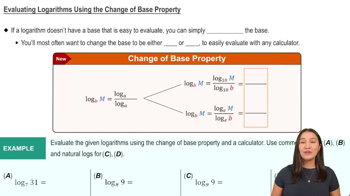
Change of Base Property

Change of Base Formula

The change of base formula allows us to convert logarithms from one base to another, expressed as \\log_b(a) = \\frac{\\log_k(a)}{\\log_k(b)} for any positive base k. This is particularly useful when dealing with logarithms that are not easily computable in their original base. It helps in simplifying complex logarithmic equations and verifying their equality.
Video consigliato:
05:36
Change of Base Property

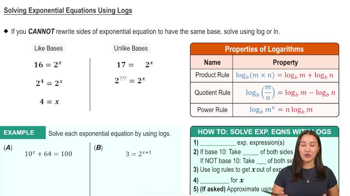
Exponential Equations

Exponential equations involve expressions where variables appear as exponents. Understanding how to manipulate these equations is crucial for solving logarithmic statements. For example, if \\log_b(a) = c, then it can be rewritten in exponential form as \\ b^c = a. This relationship is fundamental in proving or disproving logarithmic identities and statements.
Video consigliato:
5:47
Solving Exponential Equations Using Logs
Pratica correlata
Domanda del libro di testo

Determine whether the following statements are true and give an explanation or counterexample.


2=ln2e2=\(\ln\)2^{e}

227
views
Domanda del libro di testo

Determine whether the following statements are true and give an explanation or counterexample.


logbxlogby=logbx−logby\(\frac{\log_{b}\)x}{\(\log\)_{b}y}=\(\log\)_{b}x-\(\log\)_{b}y

217
views
Domanda del libro di testo

In each exercise, a function and an interval of its independent variable are given. The endpoints of the interval are associated with points PP and QQ on the graph of the function.

a. Sketch a graph of the function and the secant line through PP and QQ.

b. Find the slope of the secant line in part (a), and interpret your answer in terms of an average rate of change over the interval. Include units in your answer.

After tt seconds, an object dropped from rest falls a distance d=16t2d=16t^2, where dd is measured in feet and 2≤t≤52\(\leq{t}\)\(\leq{5}\).

486
views
Domanda del libro di testo

Roots and powers Sketch a graph of the given pairs of functions. Be sure to draw the graphs accurately relative to each other.


y = (x)¹⸍³ and y = (x)¹⸍⁵

423
views
Domanda del libro di testo

Determine whether the following statements are true and give an explanation or counterexample.


2=10log1022=10^{\(\log\)_{10}2}

191
views
Domanda del libro di testo

Explain why or why not Determine whether the following statements are true and give an explanation or counterexample.


If f(x)=x2+1f\(\left\)(x\(\right\))=x^2+1 , then f−1(x)=1x2+1f^{-1}\(\left\)(x\(\right\))=\(\frac{1}{x^2+1}\).

276
views