Ch. 1 - Functions
Briggs - Calculus: Early Transcendentals 3rd Edition
Briggs3rd EditionCalculus: Early TranscendentalsISBN: 9780136847243Non è quello che usi tu?Cambia libro di testo
Capitolo 1, Problema 77g

Explain why or why not Determine whether the following statements are true and give an explanation or counterexample.


If f(x)=1xf\(\left\)(x\(\right\))=\(\frac{1}{x}\) , then f−1(x)=1xf^{-1}\(\left\)(x\(\right\))=\(\frac{1}{x}\)

Guida verificata passo dopo passo
1
Step 1: Understand the problem statement. We are given a function \( f(x) = \frac{1}{x} \) and need to determine if its inverse \( f^{-1}(x) \) is also \( \frac{1}{x} \).
Step 2: Recall the definition of an inverse function. For a function \( f(x) \), its inverse \( f^{-1}(x) \) satisfies the condition \( f(f^{-1}(x)) = x \) and \( f^{-1}(f(x)) = x \).
Step 3: Apply the inverse function condition to \( f(x) = \frac{1}{x} \). Assume \( f^{-1}(x) = \frac{1}{x} \) and check if \( f(f^{-1}(x)) = x \). Substitute \( f^{-1}(x) \) into \( f(x) \): \( f(f^{-1}(x)) = f\left(\frac{1}{x}\right) = \frac{1}{\left(\frac{1}{x}\right)} = x \). This condition holds.
Step 4: Check the second condition \( f^{-1}(f(x)) = x \). Substitute \( f(x) \) into \( f^{-1}(x) \): \( f^{-1}(f(x)) = f^{-1}\left(\frac{1}{x}\right) = \frac{1}{\left(\frac{1}{x}\right)} = x \). This condition also holds.
Step 5: Conclude that both conditions for inverse functions are satisfied, so the statement is true. The inverse of \( f(x) = \frac{1}{x} \) is indeed \( f^{-1}(x) = \frac{1}{x} \).

Risposta video verificata per un problema simile:

Questa soluzione video è stata consigliata dai nostri tutor come utile per risolvere questo problema.
Durata del video:
2m

Concetti chiave

Ecco i concetti essenziali che devi comprendere per rispondere correttamente alla domanda.

Function and Inverse Function

A function maps each input to a single output, while an inverse function reverses this mapping. For a function f(x), the inverse f^{-1}(x) satisfies the condition f(f^{-1}(x)) = x for all x in the domain of f^{-1}. Understanding this relationship is crucial for determining whether the given statement about f(x) and its inverse is true.
Video consigliato:
06:35
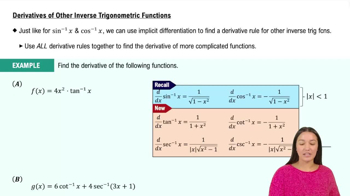
Derivatives of Other Inverse Trigonometric Functions

Domain and Range

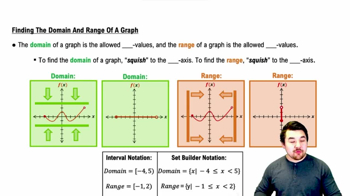
The domain of a function is the set of all possible input values, while the range is the set of all possible output values. For the function f(x) = 1/x, the domain excludes zero, as division by zero is undefined. When analyzing the inverse function, it is essential to consider how the domain and range of f affect those of f^{-1}.
Video consigliato:
Percorso guidato
5:10
Finding the Domain and Range of a Graph

Counterexamples

A counterexample is a specific case that disproves a general statement. In the context of functions and their inverses, providing a counterexample involves finding a value for which the proposed relationship does not hold. This is a critical skill in calculus, as it helps clarify the conditions under which statements about functions and their inverses are valid.