Ch. 1 - Functions
Briggs - Calculus: Early Transcendentals 3rd Edition
Briggs3rd EditionCalculus: Early TranscendentalsISBN: 9780136847243Non è quello che usi tu?Cambia libro di testo
Capitolo 1, Problema 1.R.75

Inverse sines and cosines Evaluate or simplify the following expressions without using a calculator.


sin⁻¹ ( -1 )

Guida verificata passo dopo passo
1
Understand that \( \sin^{-1}(x) \) represents the inverse sine function, also known as arcsin, which gives the angle whose sine is \( x \).
Recall that the range of \( \sin^{-1}(x) \) is \([-\frac{\pi}{2}, \frac{\pi}{2}]\), meaning it outputs angles in this interval.
Recognize that \( \sin^{-1}(-1) \) asks for the angle \( \theta \) such that \( \sin(\theta) = -1 \).
Identify that \( \sin(\theta) = -1 \) at \( \theta = -\frac{\pi}{2} \), which is within the range of the inverse sine function.
Conclude that \( \sin^{-1}(-1) = -\frac{\pi}{2} \).

Risposta video verificata per un problema simile:

Questa soluzione video è stata consigliata dai nostri tutor come utile per risolvere questo problema.
Durata del video:
2m

Concetti chiave

Ecco i concetti essenziali che devi comprendere per rispondere correttamente alla domanda.

Inverse Trigonometric Functions

Inverse trigonometric functions, such as sin⁻¹ (arcsin) and cos⁻¹ (arccos), are used to find angles when the value of a sine or cosine is known. For example, sin⁻¹(x) gives the angle whose sine is x, with a principal range typically between -π/2 and π/2 for arcsin. Understanding these functions is crucial for evaluating expressions involving inverse trigonometric values.
Video consigliato:
06:35
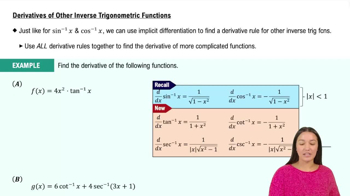
Derivatives of Other Inverse Trigonometric Functions

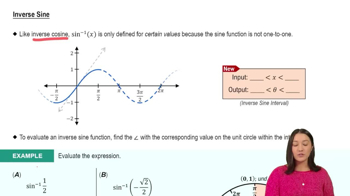
Range of Inverse Sine Function

The range of the inverse sine function, sin⁻¹(x), is limited to the interval [-π/2, π/2]. This means that when evaluating sin⁻¹(-1), we are looking for an angle within this range whose sine value is -1. Recognizing this range helps in determining the correct angle corresponding to the given sine value.
Video consigliato:
4:03
Inverse Sine

Unit Circle

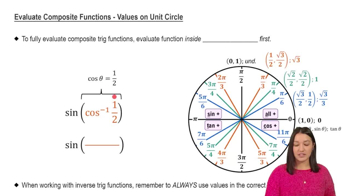
The unit circle is a fundamental concept in trigonometry that helps visualize the values of sine and cosine for various angles. It is a circle with a radius of one centered at the origin of a coordinate plane. The sine of an angle corresponds to the y-coordinate of the point on the unit circle, which aids in understanding why sin⁻¹(-1) equals -π/2, as this is the angle where the sine value reaches its minimum.
Video consigliato:
5:10
Evaluate Composite Functions - Values on Unit Circle