
Domanda del libro di testo
Finding all inverses Find all the inverses associated with the following functions, and state their domains.
ƒ(x) = (x + 1)³
235
views

 Guida verificata passo dopo passo
 4:26
4:26
 6:04
6:04 05:21
05:21Finding all inverses Find all the inverses associated with the following functions, and state their domains.
ƒ(x) = (x + 1)³
Simplify the difference quotients ƒ(x+h) - ƒ(x) / h and ƒ(x) - ƒ(a) / (x-a) by rationalizing the numerator.
ƒ(x) = - (3/√x)
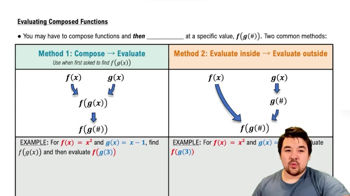
Suppose ƒ is an even function with ƒ(2) = 2 and g is an odd function with g(2) = -2. Evaluate ƒ(-2) , ƒ(g(2)), and g(ƒ(-2))
Simplify the difference quotient ƒ(x+h)-ƒ(x)/h
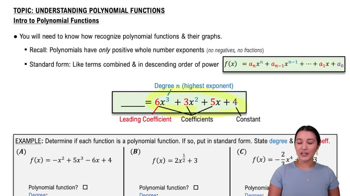
ƒ(x) = 2x² -3x +1
Properties of logarithms Assume logbx = 0.36, logby= 0.56 and logbz = 0.83 . Evaluate the following expressions.
logb (√x) / (³√z)
The National Weather Service releases approximately radiosondes every year to collect data from the atmosphere. Attached to a balloon, a radiosonde rises at about ft/min until the balloon bursts in the upper atmosphere. Suppose a radiosonde is released from a point ft above the ground and that seconds later, it is ft above the ground. Let represent the height (in feet) that the radiosonde is above the ground seconds after it is released. Evaluate and interpret the meaning of this quotient.