Ch. 1 - Functions
Briggs - Calculus: Early Transcendentals 3rd Edition
Briggs3rd EditionCalculus: Early TranscendentalsISBN: 9780136847243Non è quello che usi tu?Cambia libro di testo
Capitolo 1, Problema 86

Prove the following identities.
sinθ1+cosθ=1−cosθsinθ\(\frac{\sin\theta}{1+\cos\theta}\)=\(\frac{1-\cos\theta}{\sin\theta}\)

Guida verificata passo dopo passo
1
Start by examining the left-hand side of the identity: \( \frac{\sin\theta}{1+\cos\theta} \).
Multiply both the numerator and the denominator of the left-hand side by the conjugate of the denominator, which is \( 1-\cos\theta \). This gives: \( \frac{\sin\theta (1-\cos\theta)}{(1+\cos\theta)(1-\cos\theta)} \).
Simplify the denominator using the difference of squares formula: \((1+\cos\theta)(1-\cos\theta) = 1 - \cos^2\theta\).
Recognize that \(1 - \cos^2\theta\) is equal to \(\sin^2\theta\) by the Pythagorean identity.
Simplify the expression: \( \frac{\sin\theta (1-\cos\theta)}{\sin^2\theta} = \frac{1-\cos\theta}{\sin\theta} \), which matches the right-hand side of the identity.

Risposta video verificata per un problema simile:

Questa soluzione video è stata consigliata dai nostri tutor come utile per risolvere questo problema.
Durata del video:
3m

Concetti chiave

Ecco i concetti essenziali che devi comprendere per rispondere correttamente alla domanda.

Trigonometric Identities

Trigonometric identities are equations involving trigonometric functions that are true for all values of the variables involved. Common identities include the Pythagorean identities, reciprocal identities, and co-function identities. Understanding these identities is crucial for simplifying expressions and proving equations in trigonometry.
Video consigliato:
7:17
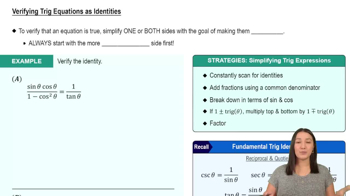
Verifying Trig Equations as Identities

Algebraic Manipulation

Algebraic manipulation involves rearranging and simplifying expressions using algebraic rules. This includes factoring, expanding, and combining like terms. Mastery of algebraic manipulation is essential for transforming one side of an equation to match the other, which is often necessary in proving identities.
Video consigliato:
05:25
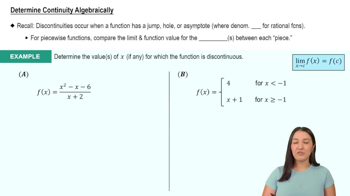
Determine Continuity Algebraically

Common Denominators

Finding a common denominator is a technique used to combine fractions or simplify expressions involving fractions. This process involves identifying a shared multiple of the denominators, allowing for the addition or comparison of fractions. In the context of trigonometric identities, this skill is vital for equating two fractions and proving their equality.
Video consigliato:
Percorso guidato
5:57
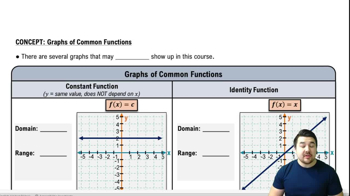
Graphs of Common Functions