Ch. 1 - Functions
Briggs - Calculus: Early Transcendentals 3rd Edition
Briggs3rd EditionCalculus: Early TranscendentalsISBN: 9780136847243Non è quello che usi tu?Cambia libro di testo
Capitolo 1, Problema 1.R.44

Solving equations Solve each equation.


ln 3x + ln (x + 2) = 0

Guida verificata passo dopo passo
1
Combine the logarithms on the left side using the property \( \ln a + \ln b = \ln(ab) \).
This gives us \( \ln(3x(x + 2)) = 0 \).
Exponentiate both sides to eliminate the natural logarithm, using the property that if \( \ln(a) = b \), then \( a = e^b \).
This results in \( 3x(x + 2) = e^0 \), which simplifies to \( 3x(x + 2) = 1 \).
Expand and solve the quadratic equation \( 3x^2 + 6x - 1 = 0 \) using the quadratic formula or factoring, if possible.

Risposta video verificata per un problema simile:

Questa soluzione video è stata consigliata dai nostri tutor come utile per risolvere questo problema.
Durata del video:
6m

Concetti chiave

Ecco i concetti essenziali che devi comprendere per rispondere correttamente alla domanda.

Properties of Logarithms

Logarithms have specific properties that simplify their manipulation. For instance, the product property states that ln(a) + ln(b) = ln(ab). This property allows us to combine logarithmic expressions, which is essential for solving equations involving logarithms.
Video consigliato:
05:36
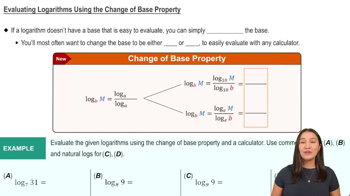
Change of Base Property

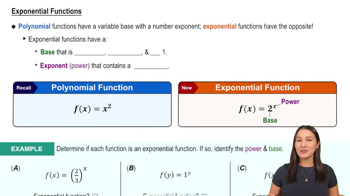
Exponential Functions

Exponential functions are the inverse of logarithmic functions. When solving logarithmic equations, converting the logarithmic form to its exponential form is often necessary. For example, if ln(y) = x, then y = e^x, which helps isolate the variable in the equation.
Video consigliato:
6:13
Exponential Functions

Domain of Logarithmic Functions

The domain of a logarithmic function is restricted to positive real numbers. This means that the arguments of logarithms must be greater than zero. Understanding this concept is crucial when solving logarithmic equations, as it ensures that the solutions found are valid within the context of the logarithmic function.
Video consigliato:
5:26
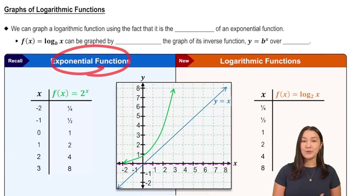
Graphs of Logarithmic Functions