

Ch. 1 - Functions
Briggs - Calculus: Early Transcendentals 3rd Edition
Briggs3rd EditionCalculus: Early TranscendentalsISBN: 9780136847243Non è quello che usi tu?Cambia libro di testo
Capitolo 1, Problema 1.3.43b

Splitting up curves The unit circle x² + y² = 1  consists of four one-to-one functions, ƒ₁ (x), ƒ₂(x) , ƒ₃(x), and ƒ₄ (x)  (see figure)<IMAGE>.


b. Find the inverse of each function and write it as y= ƒ⁻¹ (x)

Guida verificata passo dopo passo
1
Step 1: Understand the unit circle equation x^2 + y^2 = 1, which represents a circle centered at the origin with a radius of 1.
Step 2: Recognize that the unit circle can be divided into four segments, each representing a one-to-one function. These segments correspond to the four quadrants of the circle.
Step 3: Identify the four functions: f₁(x) for the top right quadrant, f₂(x) for the top left quadrant, f₃(x) for the bottom left quadrant, and f₄(x) for the bottom right quadrant.
Step 4: For each function, express y in terms of x. For example, for f₁(x), y = sqrt(1 - x^2) since it represents the top half of the circle where y is positive.
Step 5: Find the inverse of each function by solving for x in terms of y. For instance, for f₁(x), the inverse would be x = sqrt(1 - y^2), and express it as y = f⁻¹(x).

Risposta video verificata per un problema simile:

Questa soluzione video è stata consigliata dai nostri tutor come utile per risolvere questo problema.
Durata del video:
5m

Concetti chiave

Ecco i concetti essenziali che devi comprendere per rispondere correttamente alla domanda.

Inverse Functions

An inverse function essentially reverses the effect of the original function. If a function ƒ maps an input x to an output y, then its inverse ƒ⁻¹ maps y back to x. For a function to have an inverse, it must be one-to-one, meaning each output is produced by exactly one input. This concept is crucial when finding the inverse of functions derived from the unit circle.
Video consigliato:
4:49
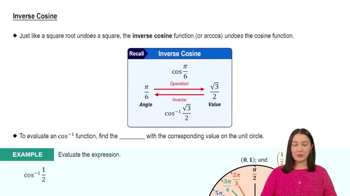
Inverse Cosine

One-to-One Functions

A one-to-one function is a function where each output is associated with exactly one input, ensuring that no two different inputs produce the same output. This property is essential for determining whether a function has an inverse. In the context of the unit circle, identifying the segments that are one-to-one allows us to find valid inverses for each segment of the curve.
Video consigliato:
05:50
One-Sided Limits

Unit Circle

The unit circle is a circle with a radius of one centered at the origin of a coordinate plane, defined by the equation x² + y² = 1. It represents all points (x, y) that are one unit away from the origin. Understanding the unit circle is fundamental in trigonometry and calculus, as it provides a geometric representation of sine, cosine, and their inverses, which are often involved in finding the inverses of functions derived from the circle.
Video consigliato:
5:10
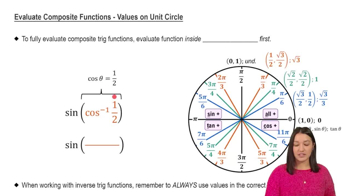
Evaluate Composite Functions - Values on Unit Circle