
Ch. 1 - Functions
Briggs - Calculus: Early Transcendentals 3rd Edition
Briggs3rd EditionCalculus: Early TranscendentalsISBN: 9780136847243Non è quello che usi tu?Cambia libro di testo
Capitolo 1, Problema 1.41c

Identify the symmetry (if any) in the graphs of the following equations.
y2−4x2=4y^2-4x^2=4

Guida verificata passo dopo passo
1
First, recognize that the given equation is in the form of a conic section. Specifically, it resembles the equation of a hyperbola: \( y^2 - 4x^2 = 4 \).
To analyze symmetry, consider the standard forms of symmetry: symmetry about the x-axis, y-axis, and the origin. For hyperbolas, symmetry is typically about the axes or the origin.
Check for symmetry about the x-axis by replacing \( y \) with \( -y \) in the equation. Substitute \( -y \) into the equation: \( (-y)^2 - 4x^2 = 4 \). Simplify to see if the equation remains unchanged.
Check for symmetry about the y-axis by replacing \( x \) with \( -x \) in the equation. Substitute \( -x \) into the equation: \( y^2 - 4(-x)^2 = 4 \). Simplify to see if the equation remains unchanged.
Check for symmetry about the origin by replacing both \( x \) with \( -x \) and \( y \) with \( -y \). Substitute into the equation: \( (-y)^2 - 4(-x)^2 = 4 \). Simplify to see if the equation remains unchanged. Analyze the results to determine the symmetry of the graph.

Risposta video verificata per un problema simile:

Questa soluzione video è stata consigliata dai nostri tutor come utile per risolvere questo problema.
Durata del video:
4m

Concetti chiave

Ecco i concetti essenziali che devi comprendere per rispondere correttamente alla domanda.

Symmetry in Graphs

Symmetry in graphs refers to the property where a graph remains unchanged under certain transformations, such as reflection or rotation. Common types of symmetry include even symmetry (about the y-axis), odd symmetry (about the origin), and symmetry about a line. Identifying symmetry helps in understanding the behavior of functions and their graphs.
Video consigliato:
Percorso guidato
06:15
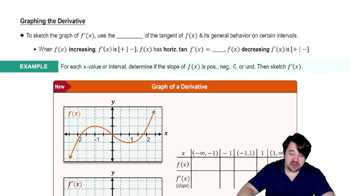
Graphing The Derivative

Conic Sections

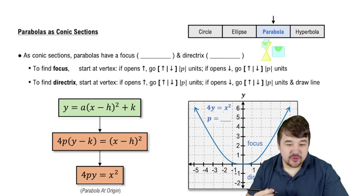
Conic sections are the curves obtained by intersecting a plane with a double-napped cone. The equation given, y² - 4x² = 4, represents a hyperbola, which is characterized by its two branches that open away from each other. Understanding the properties of conic sections is essential for analyzing their graphs and symmetries.
Video consigliato:
Percorso guidato
5:33
Parabolas as Conic Sections

Transformations of Functions

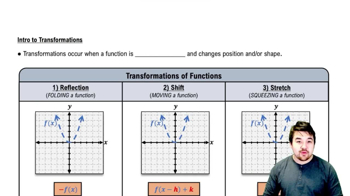
Transformations of functions involve shifting, reflecting, stretching, or compressing the graph of a function. For example, replacing y with -y reflects the graph across the x-axis, while replacing x with -x reflects it across the y-axis. These transformations are crucial for determining the symmetry of a graph, as they can reveal how the graph behaves under various operations.
Video consigliato:
Percorso guidato
5:25
Intro to Transformations
Pratica correlata
Domanda del libro di testo

A culture of bacteria has a population of 150150 cells when it is first observed. The population doubles every 12 hr12~\(\text{hr}\), which means its population is governed by the function p(t)=150⋅2t12p\(\left\)(t\(\right\))=150\(\cdot{2^{\frac{t}{12}\)}}, where tt is the number of hours after the first observation.

What is the population 4 days4~\(\text{days}\) after the first observation?

321
views
Domanda del libro di testo

Taxicab fees A taxicab ride costs \$3.50 plus \$2.50 per mile. Let m be the distance (in miles) from the airport to a hotel. Find and graph the function c(m) that represents the cost of taking a taxi from the airport to the hotel. Also determine how much it will cost if the hotel is 9 miles from the airport.

312
views
Domanda del libro di testo

Inverse of composite functions


c. Explain why if g and h are one-to-one, the inverse of ƒ(x) = g(h(x)) exists.

319
views
Domanda del libro di testo

Inverse of composite functions


b. Let g(x) = x² + 1 and h(x) = √x. Consider the composite function ƒ(x) = g(h(x)). Find ƒ⁻¹ directly and then express it in terms of g⁻¹ and h⁻¹

302
views
Domanda del libro di testo

Composite functions

Let ƒ(x) = x³, g (x) = sin x and h(x) = √x .

Find the domain of ƒ o g.

489
views
Domanda del libro di testo

A culture of bacteria has a population of 150150 cells when it is first observed. The population doubles every 12 hr12~\(\text{hr}\), which means its population is governed by the function p(t)=150⋅2t12p\(\left\)(t\(\right\))=150\(\cdot{2^{\frac{t}{12}\)}}, where tt is the number of hours after the first observation.

How long does it take the population to triple in size?

285
views