Ch. 10 - Sequences and Infinite Series
Briggs - Calculus: Early Transcendentals 3rd Edition
Briggs3rd EditionCalculus: Early TranscendentalsISBN: 9780136847243Non è quello che usi tu?Cambia libro di testo
Capitolo 10, Problema 10.8.9

1–10. Choosing convergence tests Identify a convergence test for each series. If necessary, explain how to simplify or rewrite the series before applying the convergence test. You do not need to carry out the convergence test.
∑ (from k = 1 to ∞) ((−1)ᵏ⁺¹) / (√2ᵏ + lnk)

Guida verificata passo dopo passo
1
Identify the type of series given: \( \sum_{k=1}^{\infty} \frac{(-1)^{k+1}}{\sqrt{2^k} + \ln k} \). Notice the presence of the alternating factor \( (-1)^{k+1} \), which suggests this is an alternating series.
Rewrite the denominator to understand the behavior of the terms better. Since \( \sqrt{2^k} = (2^k)^{1/2} = 2^{k/2} \), the general term can be expressed as \( \frac{(-1)^{k+1}}{2^{k/2} + \ln k} \).
Consider the non-alternating part of the term, \( a_k = \frac{1}{2^{k/2} + \ln k} \), to analyze its limit and monotonicity, which are important for applying the Alternating Series Test.
Since \( 2^{k/2} \) grows exponentially and dominates \( \ln k \) for large \( k \), the terms \( a_k \) decrease and approach zero as \( k \to \infty \). This supports the use of the Alternating Series Test.
Therefore, the appropriate convergence test to identify here is the Alternating Series Test (Leibniz Test), applied to the series after recognizing the alternating sign and analyzing the behavior of the positive term \( a_k \).

Risposta video verificata per un problema simile:

Questa soluzione video è stata consigliata dai nostri tutor come utile per risolvere questo problema.
Durata del video:
6m

Concetti chiave

Ecco i concetti essenziali che devi comprendere per rispondere correttamente alla domanda.

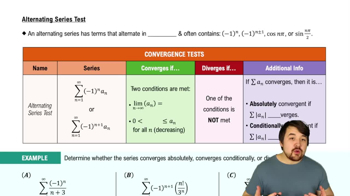
Alternating Series Test

This test determines the convergence of series whose terms alternate in sign, like those with factors of (−1)^k. It requires that the absolute value of terms decreases monotonically to zero. If these conditions hold, the series converges, even if it does not converge absolutely.
Video consigliato:
Percorso guidato
10:54
Alternating Series Test

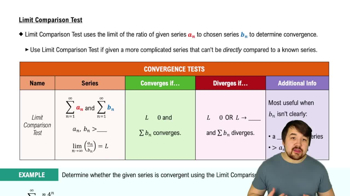
Comparison and Limit Comparison Tests

These tests compare a given series to a known benchmark series to determine convergence. By simplifying or bounding terms, one can relate the series to a p-series or geometric series. The limit comparison test uses the limit of the ratio of terms to decide if both series share the same convergence behavior.
Video consigliato:
Percorso guidato
07:45
Limit Comparison Test

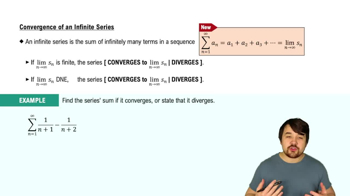
Simplifying Series Terms for Convergence Analysis

Before applying convergence tests, it is often helpful to rewrite or approximate terms to identify dominant behavior. For example, recognizing that √2^k grows exponentially while ln k grows slowly helps in comparing terms to simpler series. This simplification guides the choice of the most appropriate convergence test.
Video consigliato:
Percorso guidato
06:52
Convergence of an Infinite Series