Ch. 10 - Sequences and Infinite Series
Briggs - Calculus: Early Transcendentals 3rd Edition
Briggs3rd EditionCalculus: Early TranscendentalsISBN: 9780136847243Non è quello che usi tu?Cambia libro di testo
Capitolo 10, Problema 10.6.21

11–27. Alternating Series Test Determine whether the following series converge.
∑ (k = 2 to ∞) (−1)ᵏ (1 + 1/k)

Guida verificata passo dopo passo
1
Identify the general term of the series: \( a_k = (-1)^k \left(1 + \frac{1}{k}\right) \). This is an alternating series because of the factor \((-1)^k\), which causes the terms to alternate in sign.
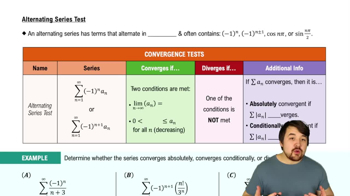
Recall the Alternating Series Test (Leibniz Test), which states that an alternating series \( \sum (-1)^k b_k \) converges if two conditions are met: (1) the sequence \( b_k \) is positive, decreasing, and (2) \( \lim_{k \to \infty} b_k = 0 \).
Rewrite the series terms without the alternating sign to identify \( b_k \): \( b_k = 1 + \frac{1}{k} \). Note that \( b_k \) must be positive and decreasing for the test to apply.
Check if \( b_k = 1 + \frac{1}{k} \) is decreasing. Since \( 1 + \frac{1}{k} \) decreases as \( k \) increases, verify this by comparing \( b_k \) and \( b_{k+1} \).
Evaluate the limit \( \lim_{k \to \infty} b_k = \lim_{k \to \infty} \left(1 + \frac{1}{k}\right) \). If this limit is zero, the series converges by the Alternating Series Test; if not, the test fails and the series diverges.

Risposta video verificata per un problema simile:

Questa soluzione video è stata consigliata dai nostri tutor come utile per risolvere questo problema.
Durata del video:
2m

Concetti chiave

Ecco i concetti essenziali che devi comprendere per rispondere correttamente alla domanda.

Alternating Series Test

The Alternating Series Test determines if a series with terms alternating in sign converges. It requires that the absolute value of the terms decreases monotonically to zero. If these conditions hold, the series converges, even if it does not converge absolutely.
Video consigliato:
Percorso guidato
10:54
Alternating Series Test

Behavior of the General Term

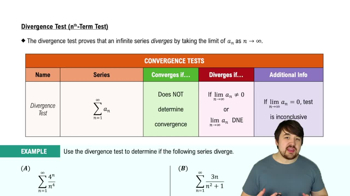
Analyzing the general term (1 + 1/k) is crucial to check if it approaches zero as k approaches infinity. For convergence of an alternating series, the terms must tend to zero; if they do not, the series diverges regardless of sign alternation.
Video consigliato:
Percorso guidato
05:44
Divergence Test (nth Term Test)

Absolute vs Conditional Convergence

Absolute convergence occurs if the series of absolute values converges, implying stronger convergence. Conditional convergence happens when the alternating series converges but the absolute series diverges. Understanding this distinction helps classify the series' convergence type.
Video consigliato:
Percorso guidato
07:51
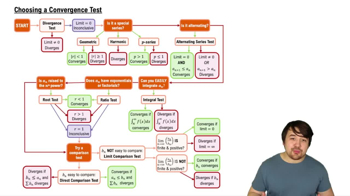
Choosing a Convergence Test
Pratica correlata
Domanda del libro di testo

55–70. More sequences

Find the limit of the following sequences or determine that the sequence diverges.


{sinn / 2ⁿ}

52
views

Domanda del libro di testo

84–87. {Use of Tech} Sequences by recurrence relations

The following sequences, defined by a recurrence relation, are monotonic and bounded, and therefore converge by Theorem 10.5.


a.Examine the first three terms of the sequence to determine whether the sequence is nondecreasing or nonincreasing.

b.Use analytical methods to find the limit of the sequence.


{Use of Tech}aₙ₊₁ = √(2 + aₙ);a₀ = 3

45
views
Domanda del libro di testo

Series of squares Prove that if ∑aₖ is a convergent series of positive terms, then the series ∑aₖ² also converges.

71
views
Domanda del libro di testo

48–63. Choose your test Determine whether the following series converge or diverge using the properties and tests introduced in Sections 10.3 and 10.4.

∑ (k = 1 to ∞) (5 / 6)⁻ᵏ

57
views
Domanda del libro di testo

1–10. Choosing convergence tests Identify a convergence test for each series. If necessary, explain how to simplify or rewrite the series before applying the convergence test. You do not need to carry out the convergence test.

∑ (from k = 10 to ∞) 1 / (k − 9)⁵

38
views
Domanda del libro di testo

35–44. Limits of sequences Write the terms a₁, a₂, a₃, and a₄ of the following sequences. If the sequence appears to converge, make a conjecture about its limit. If the sequence diverges, explain why. 

aₙ = 1⁄10ⁿ; n = 1, 2, 3, …

46
views