
Ch. 10 - Sequences and Infinite Series
Briggs - Calculus: Early Transcendentals 3rd Edition
Briggs3rd EditionCalculus: Early TranscendentalsISBN: 9780136847243Non è quello che usi tu?Cambia libro di testo
Capitolo 10, Problema 10.8.83

11–86. Applying convergence tests Determine whether the following series converge. Justify your answers.
∑ (from j = 2 to ∞)1 / (j ln¹⁰j)

Guida verificata passo dopo passo
1
Identify the series given: \( \sum_{j=2}^{\infty} \frac{1}{j (\ln j)^{10}} \). This is a positive term series, so we can consider convergence tests suitable for positive series.
Recognize that the series resembles a p-series with an additional logarithmic factor in the denominator. Since \( j \) grows linearly and \( (\ln j)^{10} \) grows slower than any power of \( j \), we should consider the Integral Test for convergence.
Set up the Integral Test by considering the integral \( \int_{2}^{\infty} \frac{1}{x (\ln x)^{10}} \, dx \). If this improper integral converges, then the series converges; if it diverges, the series diverges.
Make the substitution \( u = \ln x \), which implies \( du = \frac{1}{x} dx \). This transforms the integral into \( \int_{\ln 2}^{\infty} \frac{1}{u^{10}} \, du \).
Evaluate the integral \( \int_{\ln 2}^{\infty} u^{-10} \, du \). Since this is an integral of a power function \( u^{-p} \) with \( p = 10 > 1 \), it converges. Therefore, by the Integral Test, the original series converges.

Risposta video verificata per un problema simile:

Questa soluzione video è stata consigliata dai nostri tutor come utile per risolvere questo problema.
Durata del video:
8m

Concetti chiave

Ecco i concetti essenziali che devi comprendere per rispondere correttamente alla domanda.

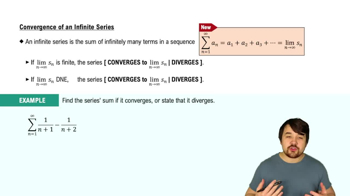
Convergence of Infinite Series

An infinite series converges if the sequence of its partial sums approaches a finite limit. Understanding convergence is essential to determine whether the sum of infinitely many terms results in a finite value or diverges to infinity or oscillates.
Video consigliato:
Percorso guidato
06:52
Convergence of an Infinite Series

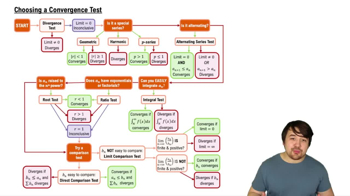
Integral Test for Convergence

The integral test compares a series to an improper integral of a related function. If the integral of f(x) from some point to infinity converges, then the series ∑f(n) also converges, and vice versa. This test is especially useful for series with positive, decreasing terms.
Video consigliato:
Percorso guidato
07:51
Choosing a Convergence Test

Behavior of Logarithmic Functions in Series

Logarithmic functions grow slowly, and their powers affect convergence rates. In series like ∑ 1/(j (ln j)^p), the exponent p determines convergence: the series converges if p > 1 and diverges if p ≤ 1, highlighting the importance of understanding how logarithmic terms influence series behavior.
Video consigliato:
5:26
Graphs of Logarithmic Functions