Ch. 10 - Sequences and Infinite Series
Briggs - Calculus: Early Transcendentals 3rd Edition
Briggs3rd EditionCalculus: Early TranscendentalsISBN: 9780136847243Non è quello che usi tu?Cambia libro di testo
Capitolo 10, Problema 10.2.49

13–52. Limits of sequences
Find the limit of the following sequences or determine that the sequence diverges.


{bₙ}, where
bₙ = { n / (n + 1)if n ≤ 5000
ne⁻ⁿif n > 5000 }

Guida verificata passo dopo passo
1
Understand the definition of the sequence \( b_n \): it has two different expressions depending on whether \( n \) is less than or equal to 5000 or greater than 5000.
Analyze the first part of the sequence for \( n \leq 5000 \): \( b_n = \frac{n}{n+1} \). Since this is a rational function, consider the limit as \( n \to \infty \) to understand its behavior.
Analyze the second part of the sequence for \( n > 5000 \): \( b_n = n e^{-n} \). Recognize that \( e^{-n} = \frac{1}{e^n} \) and consider the limit as \( n \to \infty \) to determine how this term behaves.
Since the sequence changes definition at \( n = 5000 \), check the limit of both parts as \( n \to \infty \) to see if they approach the same value or if the sequence diverges.
Conclude the overall limit of the sequence \( b_n \) by combining the results from both parts and considering the behavior for large \( n \).

Risposta video verificata per un problema simile:

Questa soluzione video è stata consigliata dai nostri tutor come utile per risolvere questo problema.
Durata del video:
1m

Concetti chiave

Ecco i concetti essenziali che devi comprendere per rispondere correttamente alla domanda.

Limit of a Sequence

The limit of a sequence is the value that the terms of the sequence approach as the index n goes to infinity. If the terms get arbitrarily close to a specific number, the sequence converges to that limit; otherwise, it diverges.
Video consigliato:
8:22
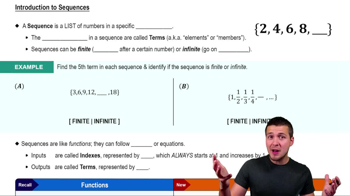
Introduction to Sequences

Piecewise-Defined Sequences

A piecewise-defined sequence has different formulas for different ranges of n. To find its limit, analyze the behavior of each piece separately, especially the part that applies as n approaches infinity.
Video consigliato:
Percorso guidato
05:36
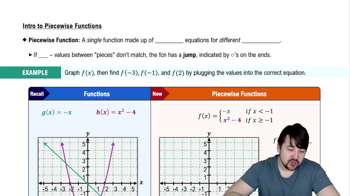
Piecewise Functions

Exponential Decay and Its Limit

Sequences involving terms like n·e⁻ⁿ combine polynomial growth with exponential decay. Since exponential decay dominates polynomial growth, such terms tend to zero as n approaches infinity.
Video consigliato:
09:29
Exponential Growth & Decay