Ch. 10 - Sequences and Infinite Series
Briggs - Calculus: Early Transcendentals 3rd Edition
Briggs3rd EditionCalculus: Early TranscendentalsISBN: 9780136847243Non è quello che usi tu?Cambia libro di testo
Capitolo 10, Problema 10.3.19a

18–20. Evaluating geometric series two ways Evaluate each geometric series two ways.


a. Find the nth partial sum Sₙ of the series and evaluate lim (as n → ∞) Sₙ.


∑ (k = 0 to ∞) (–2/7)ᵏ

Guida verificata passo dopo passo
1
Identify the first term \( a \) and the common ratio \( r \) of the geometric series. Here, \( a = 1 \) (since when \( k=0 \), \( (-2/7)^0 = 1 \)) and \( r = -\frac{2}{7} \).
Write the formula for the nth partial sum \( S_n \) of a geometric series: \[ S_n = a \frac{1 - r^{n+1}}{1 - r} \]
Substitute the values of \( a \) and \( r \) into the formula to express \( S_n \) explicitly: \[ S_n = 1 \times \frac{1 - \left(-\frac{2}{7}\right)^{n+1}}{1 - \left(-\frac{2}{7}\right)} \]
Evaluate the limit of \( S_n \) as \( n \to \infty \). Since \( |r| = \frac{2}{7} < 1 \), the term \( r^{n+1} \) approaches zero, so the limit is: \[ \lim_{n \to \infty} S_n = \frac{1}{1 - \left(-\frac{2}{7}\right)} \]
Simplify the expression for the limit to find the sum of the infinite geometric series.

Risposta video verificata per un problema simile:

Questa soluzione video è stata consigliata dai nostri tutor come utile per risolvere questo problema.
Durata del video:
2m

Concetti chiave

Ecco i concetti essenziali che devi comprendere per rispondere correttamente alla domanda.

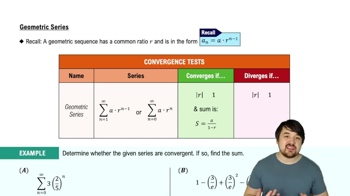
Geometric Series

A geometric series is a sum of terms where each term is found by multiplying the previous term by a constant ratio. It has the form ∑ ar^k, where a is the first term and r is the common ratio. Understanding this structure is essential for finding partial sums and limits.
Video consigliato:
Percorso guidato
06:00
Geometric Series

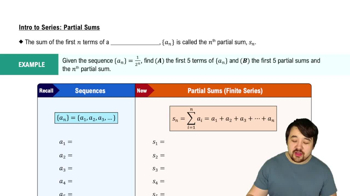
Partial Sum of a Geometric Series

The nth partial sum Sₙ of a geometric series is the sum of the first n+1 terms. It can be calculated using the formula Sₙ = a(1 - r^(n+1)) / (1 - r) when r ≠ 1. This formula helps in evaluating the series up to a finite number of terms.
Video consigliato:
Percorso guidato
06:45
Intro to Series: Partial Sums

Limit of an Infinite Geometric Series

If the absolute value of the common ratio |r| < 1, the infinite geometric series converges, and its sum is the limit of the partial sums as n approaches infinity. This limit is given by S = a / (1 - r), providing the sum of infinitely many terms.
Video consigliato:
Percorso guidato
06:00
Geometric Series
Pratica correlata
Domanda del libro di testo

41–44. {Use of Tech} Remainders and estimates Consider the following convergent series.


a. Find an upper bound for the remainder in terms of n.


43. ∑ (k = 1 to ∞) 1 / 3ᵏ

154
views

Domanda del libro di testo

57–60. Heights of bouncing balls A ball is thrown upward to a height of hₒ meters. After each bounce, the ball rebounds to a fraction r of its previous height. Let hₙ be the height after the nth bounce. Consider the following values of hₒ and r.


a. Find the first four terms of the sequence of heights {hₙ}.


h₀ = 30,r = 0.25

54
views
Domanda del libro di testo

72–75. {Use of Tech} Practical sequences

Consider the following situations that generate a sequence


a.Write out the first five terms of the sequence.


Drug elimination

Jack took a 200-mg dose of a pain killer at midnight. Every hour, 5% of the drug is washed out of his bloodstream. Let dₙ be the amount of drug in Jack’s blood n hours after the drug was taken, where d₀ = 200mg.

43
views
Domanda del libro di testo

67–70. Formulas for sequences of partial sums Consider the following infinite series.


a.Find the first four partial sums S₁, S₂, S₃, S₄ of the series.


∑⁽∞⁾ₖ₌₁2⁄[(2k − 1)(2k + 1)]

89
views
Domanda del libro di testo

Find the first term a and the ratio r of each geometric series.


a. ∑ k = 0 to ∞(2/3) × (1/5)ᵏ

63
views
Domanda del libro di testo

{Use of Tech} Periodic dosing

Many people take aspirin on a regular basis as a preventive measure for heart disease. Suppose a person takes 80 mg of aspirin every 24 hours. Assume aspirin has a half-life of 24 hours; that is, every 24 hours, half of the drug in the blood is eliminated.


a.Find a recurrence relation for the sequence {dₙ} that gives the amount of drug in the blood after the nᵗʰ dose, where d₁ = 80.

44
views