Finding steady states using infinite series Solve Exercise 40 by expressing the amount of aspirin in your blood as a geometric series and evaluating the series.
Ch. 10 - Sequences and Infinite Series
Briggs3rd EditionCalculus: Early TranscendentalsISBN: 9780136847243Non è quello che usi tu?Cambia libro di testo
Capitolo 10, Problema 10.R.25b
25–26. Recursively defined sequences
The following sequences {aₙ} from n = 0 to ∞ are defined by a recurrence relation. Assume each sequence is monotonic and bounded.
b.Determine the limit of each sequence.
25.aₙ₊₁ = (1 / 2) aₙ + 8;a₀ = 80
Guida verificata passo dopo passo1
Identify the recurrence relation given: \(a_{n+1} = \frac{1}{2} a_n + 8\) with initial value \(a_0 = 80\).
Assuming the sequence converges to a limit \(L\), use the property that as \(n \to \infty\), \(a_n\) and \(a_{n+1}\) both approach \(L\).
Set up the equation for the limit by substituting \(a_n = L\) and \(a_{n+1} = L\) into the recurrence relation: \(L = \frac{1}{2} L + 8\).
Solve the resulting algebraic equation for \(L\) to find the limit of the sequence.
Verify that the sequence is monotonic and bounded to confirm that the limit found is valid.

Risposta video verificata per un problema simile:
Questa soluzione video è stata consigliata dai nostri tutor come utile per risolvere questo problema.
Durata del video:
1mConcetti chiave
Ecco i concetti essenziali che devi comprendere per rispondere correttamente alla domanda.
Recursively Defined Sequences
A recursively defined sequence is one where each term is defined based on one or more previous terms using a recurrence relation. Understanding how to express terms in terms of earlier ones is essential for analyzing the sequence's behavior and finding limits.
Video consigliato:
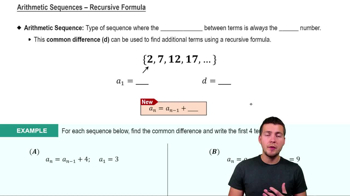
Arithmetic Sequences - Recursive Formula
Monotonicity and Boundedness
A sequence is monotonic if it is either non-increasing or non-decreasing, and bounded if its terms lie within fixed upper and lower limits. These properties guarantee the existence of a limit for the sequence, which is crucial when determining convergence.
Finding Limits of Linear Recurrence Relations
For linear recurrence relations like aₙ₊₁ = r aₙ + c, the limit can be found by setting the limit L equal to its own recurrence: L = rL + c. Solving this equation gives the sequence's limit, assuming |r| < 1 to ensure convergence.
Video consigliato:
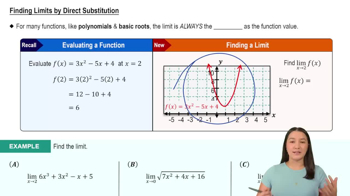
Finding Limits by Direct Substitution
Pratica correlata
Domanda del libro di testo
53
views
Domanda del libro di testo
27–37. Evaluating series Evaluate the following infinite series or state that the series diverges.
∑ (from k = 1 to ∞)ln((2k + 1) / (2k − 1))
35
views
Domanda del libro di testo
12–24. Limits of sequences Evaluate the limit of the sequence or state that it does not exist.
aₙ = (–1)ⁿ / 0.9ⁿ
48
views
Domanda del libro di testo
11–86. Applying convergence tests Determine whether the following series converge. Justify your answers.
∑ (from k = 1 to ∞)sin(1 / k⁹)
46
views
Domanda del libro di testo
{Use of Tech} Error in a finite alternating sum
How many terms of the series ∑ (from k = 1 to ∞)(−1)ᵏ⁺¹ / k⁴ must be summed to ensure that the approximation error is less than 10⁻⁸?
62
views
Domanda del libro di testo
77–87. Absolute or conditional convergence
Determine whether the following series converge absolutely, converge conditionally, or diverge.
∑ (from k = 1 to ∞)(−1)ᵏ⁺¹(k² + 4) / (2k² + 1)
76
views