
Ch. 10 - Sequences and Infinite Series
Briggs - Calculus: Early Transcendentals 3rd Edition
Briggs3rd EditionCalculus: Early TranscendentalsISBN: 9780136847243Non è quello che usi tu?Cambia libro di testo
Capitolo 10, Problema 10.5.59

40–62. Choose your test Use the test of your choice to determine whether the following series converge.
∑ (k = 1 to ∞) tan(1 / k)

Guida verificata passo dopo passo
1
Identify the series given: \( \sum_{k=1}^{\infty} \tan\left(\frac{1}{k}\right) \). We want to determine if this series converges or diverges.
Recall that for large \( k \), \( \frac{1}{k} \) approaches 0, so consider the behavior of \( \tan(x) \) as \( x \to 0 \). Use the fact that \( \tan(x) \approx x \) when \( x \) is close to 0.
Approximate the terms of the series for large \( k \): \( \tan\left(\frac{1}{k}\right) \approx \frac{1}{k} \). This suggests the series behaves similarly to the harmonic series \( \sum \frac{1}{k} \).
Since the harmonic series \( \sum \frac{1}{k} \) diverges, use the Limit Comparison Test with \( a_k = \tan\left(\frac{1}{k}\right) \) and \( b_k = \frac{1}{k} \). Compute \( \lim_{k \to \infty} \frac{a_k}{b_k} \).
If the limit is a finite nonzero number, then both series either converge or diverge together. Since \( \sum \frac{1}{k} \) diverges, conclude the behavior of the original series accordingly.

Risposta video verificata per un problema simile:

Questa soluzione video è stata consigliata dai nostri tutor come utile per risolvere questo problema.
Durata del video:
2m

Concetti chiave

Ecco i concetti essenziali che devi comprendere per rispondere correttamente alla domanda.

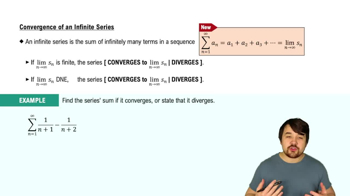
Convergence of Infinite Series

An infinite series converges if the sequence of its partial sums approaches a finite limit. Understanding convergence is essential to determine whether the sum of infinitely many terms results in a finite value or diverges to infinity or oscillates.
Video consigliato:
Percorso guidato
06:52
Convergence of an Infinite Series

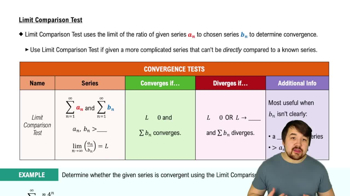
Comparison and Limit Comparison Tests

These tests compare the given series to a known benchmark series to determine convergence. The limit comparison test involves taking the limit of the ratio of terms from two series, helping to conclude convergence or divergence based on the behavior of the simpler series.
Video consigliato:
Percorso guidato
07:45
Limit Comparison Test

Behavior of tan(1/k) for Large k

As k approaches infinity, 1/k approaches zero, and tan(1/k) behaves similarly to 1/k because tan(x) ~ x near zero. Recognizing this helps approximate the series terms and apply appropriate convergence tests by comparing to the harmonic series.
Video consigliato:
08:43
Newton's Law of Cooling Example 5
Pratica correlata
Domanda del libro di testo

The first ten terms of the sequence {(1 + 1/10ⁿ)^10ⁿ}∞ ₙ₌₁ are rounded to 8 digits right of the decimal point (see table). Make a conjecture about the limit of the sequence.

n an

1 2.59374246

2 2.70481383

3 2.71692393

4 2.71814593

5 2.71826824

6 2.71828047

7 2.71828169

8 2.71828179

9 2.71828204

10 2.71828203

60
views
Domanda del libro di testo

9–15. Geometric sums Evaluate each geometric sum.


{Use of Tech}∑ k = 0 to 9(−3/4)ᵏ

34
views
Domanda del libro di testo

61–66. Sequences of partial sums For the following infinite series, find the first four terms of the sequence of partial sums. Then make a conjecture about the value of the infinite series or state that the series diverges.


4 + 0.9 + 0.09 + 0.009 + ⋯  

84
views
Domanda del libro di testo

45–48. {Use of Tech} Explicit formulas for sequences Consider the formulas for the following sequences {aₙ}ₙ₌₁∞

 Make a table with at least ten terms and determine a plausible limit of the sequence or state that the sequence diverges.

aₙ = ⁿ² + n ;n = 1, 2, 3, …

47
views
Domanda del libro di testo

32–49. Choose your test Use the test of your choice to determine whether the following series converge absolutely, converge conditionally, or diverge.

∑ (from k = 1 to ∞) 2ᵏ k! / kᵏ

46
views
Domanda del libro di testo

54–69. Telescoping series

For the following telescoping series, find a formula for the nth term of the sequence of partial sums {Sₙ}. Then evaluate limₙ→∞ Sₙ to obtain the value of the series or state that the series diverges.


65. ∑ (k = 1 to ∞) (1 / √(k + 1) – 1 / √(k + 3))

112
views