Ch. 10 - Sequences and Infinite Series
Briggs - Calculus: Early Transcendentals 3rd Edition
Briggs3rd EditionCalculus: Early TranscendentalsISBN: 9780136847243Non è quello che usi tu?Cambia libro di testo
Capitolo 10, Problema 10.3.43

43–44. Periodic doses
Suppose you take a dose of m mg of a particular medication once per day. Assume f equals the fraction of the medication that remains in your blood one day later. Just after taking another dose of medication on the second day, the amount of medication in your blood equals the sum of the second dose and the fraction of the first dose remaining in your blood, which is m + mf. Continuing in this fashion, the amount of medication in your blood just after your nth dose is


Aₙ = m + mf + ⋯ + mfⁿ⁻¹.


For the given values of f and m, calculate A₅, A₁₀, A₃₀, and lim (n → ∞) Aₙ. Interpret the meaning of the limit lim (n → ∞) Aₙ.


43.f = 0.25,m = 200 mg

Guida verificata passo dopo passo
1
Recognize that the amount of medication in the blood just after the nth dose, \(A_n\), is given by the sum of a geometric series: \[A_n = m + mf + mf^{2} + \cdots + mf^{n-1}.\]
Identify the first term \(a\) and common ratio \(r\) of the geometric series: \[a = m, \quad r = f.\]
Use the formula for the sum of the first \(n\) terms of a geometric series: \[A_n = m \frac{1 - f^{n}}{1 - f}.\]
Calculate \(A_5\), \(A_{10}\), and \(A_{30}\) by substituting \(n = 5, 10, 30\) respectively, along with the given values \(m = 200\) and \(f = 0.25\), into the formula above (do not compute the final numerical values here).
Find the limit as \(n\) approaches infinity: \[\lim_{n \to \infty} A_n = \lim_{n \to \infty} m \frac{1 - f^{n}}{1 - f} = \frac{m}{1 - f}\] Interpret this limit as the steady-state amount of medication in the blood after many doses, where the amount stabilizes because the medication eliminated each day balances the new dose taken.

Risposta video verificata per un problema simile:

Questa soluzione video è stata consigliata dai nostri tutor come utile per risolvere questo problema.
Durata del video:
3m

Concetti chiave

Ecco i concetti essenziali che devi comprendere per rispondere correttamente alla domanda.

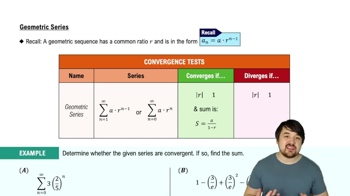
Geometric Series

A geometric series is a sum of terms where each term is a constant multiple (common ratio) of the previous one. In this problem, the medication amounts form a geometric series with first term m and ratio f. Understanding how to sum such series is essential to find the total medication after n doses.
Video consigliato:
Percorso guidato
06:00
Geometric Series

Limit of a Geometric Series

When the common ratio f satisfies |f| < 1, the infinite geometric series converges to a finite limit. This limit represents the steady-state amount of medication in the blood after many doses, showing how the drug accumulates and stabilizes over time.
Video consigliato:
Percorso guidato
06:00
Geometric Series

Interpretation of the Limit in Context

The limit of Aₙ as n approaches infinity represents the maximum stable concentration of medication in the blood. It reflects the balance between daily dosing and the fraction of drug eliminated, helping to understand long-term drug accumulation and dosing effectiveness.
Video consigliato:
05:50
One-Sided Limits