Ch. 10 - Sequences and Infinite Series
Briggs - Calculus: Early Transcendentals 3rd Edition
Briggs3rd EditionCalculus: Early TranscendentalsISBN: 9780136847243Non è quello che usi tu?Cambia libro di testo
Capitolo 10, Problema 10.3.79

72–86. Evaluating series Evaluate each series or state that it diverges.
∑ (k = 2 to ∞) ln((k + 1)k⁻¹) / (ln k × ln(k + 1))

Guida verificata passo dopo passo
1
First, rewrite the general term of the series to simplify the expression inside the summation. The term is given by \(\frac{\ln\left((k+1)k^{-1}\right)}{\ln k \times \ln(k+1)}\). Use the logarithm property \(\ln(a/b) = \ln a - \ln b\) to rewrite the numerator as \(\ln(k+1) - \ln k\).
Substitute the simplified numerator back into the term to get \(\frac{\ln(k+1) - \ln k}{\ln k \times \ln(k+1)}\). Then, separate this fraction into two parts: \(\frac{\ln(k+1)}{\ln k \times \ln(k+1)} - \frac{\ln k}{\ln k \times \ln(k+1)}\).
Simplify each part of the separated fraction. The first part simplifies to \(\frac{1}{\ln k}\) and the second part simplifies to \(\frac{1}{\ln(k+1)}\). So the general term becomes \(\frac{1}{\ln k} - \frac{1}{\ln(k+1)}\).
Recognize that the series is telescoping because each term is of the form \(a_k - a_{k+1}\), where \(a_k = \frac{1}{\ln k}\). Write out the first few terms explicitly to see the cancellation pattern.
Use the telescoping property to express the partial sum \(S_n = \sum_{k=2}^n \left( \frac{1}{\ln k} - \frac{1}{\ln(k+1)} \right)\) as \(\frac{1}{\ln 2} - \frac{1}{\ln(n+1)}\). Then analyze the limit of \(S_n\) as \(n \to \infty\) to determine whether the series converges or diverges.

Risposta video verificata per un problema simile:

Questa soluzione video è stata consigliata dai nostri tutor come utile per risolvere questo problema.
Durata del video:
5m

Concetti chiave

Ecco i concetti essenziali che devi comprendere per rispondere correttamente alla domanda.

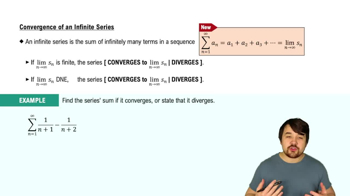
Convergence and Divergence of Infinite Series

An infinite series converges if the sum of its terms approaches a finite limit as the number of terms grows indefinitely. Otherwise, it diverges. Determining convergence often involves applying tests that analyze the behavior of the terms or partial sums.
Video consigliato:
Percorso guidato
06:52
Convergence of an Infinite Series

Properties of Logarithms

Logarithmic properties, such as ln(a/b) = ln(a) - ln(b) and ln(ab) = ln(a) + ln(b), help simplify complex expressions. Recognizing these can transform the series terms into simpler forms, making it easier to analyze or compare with known series.
Video consigliato:
05:36
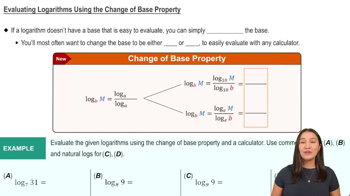
Change of Base Property

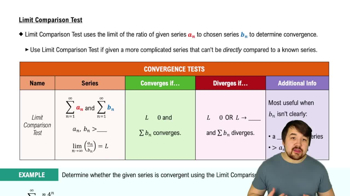
Comparison and Limit Comparison Tests

These tests compare a given series to a known benchmark series to determine convergence. The limit comparison test uses the limit of the ratio of terms from two series; if the limit is finite and positive, both series share the same convergence behavior.
Video consigliato:
Percorso guidato
07:45
Limit Comparison Test
Pratica correlata
Domanda del libro di testo

40–62. Choose your test Use the test of your choice to determine whether the following series converge.

∑ (k = 1 to ∞) 1 / k^(1 + p),p > 0

47
views

Domanda del libro di testo

48–63. Choose your test Determine whether the following series converge or diverge using the properties and tests introduced in Sections 10.3 and 10.4.

∑ (k = 1 to ∞) (5 / 6)⁻ᵏ

57
views
Domanda del libro di testo

1–10. Choosing convergence tests Identify a convergence test for each series. If necessary, explain how to simplify or rewrite the series before applying the convergence test. You do not need to carry out the convergence test.

∑ (from k = 10 to ∞) 1 / (k − 9)⁵

38
views
Domanda del libro di testo

35–44. Limits of sequences Write the terms a₁, a₂, a₃, and a₄ of the following sequences. If the sequence appears to converge, make a conjecture about its limit. If the sequence diverges, explain why. 

aₙ = 1⁄10ⁿ; n = 1, 2, 3, …

46
views
Domanda del libro di testo

1–10. Choosing convergence tests Identify a convergence test for each series. If necessary, explain how to simplify or rewrite the series before applying the convergence test. You do not need to carry out the convergence test.

∑ (from k = 3 to ∞) (2k²) / (k² − k − 2)

65
views
Domanda del libro di testo

6–9. Determine whether the following sequences converge or diverge, and state whether they are monotonic or whether they oscillate. Give the limit when the sequence converges.


{(−0.7)ⁿ}

77
views