Ch. 10 - Sequences and Infinite Series
Briggs - Calculus: Early Transcendentals 3rd Edition
Briggs3rd EditionCalculus: Early TranscendentalsISBN: 9780136847243Non è quello che usi tu?Cambia libro di testo
Capitolo 10, Problema 10.4.15

9–16. Divergence Test Use the Divergence Test to determine whether the following series diverge or state that the test is inconclusive.
∑ (k = 2 to ∞) √k / (ln¹⁰ k)

Guida verificata passo dopo passo
1
Identify the general term of the series: \( a_k = \frac{\sqrt{k}}{(\ln k)^{10}} \) for \( k \geq 2 \).
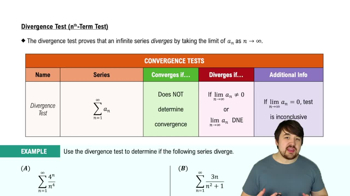
Recall the Divergence Test (also known as the Test for Divergence): if \( \lim_{k \to \infty} a_k \neq 0 \), then the series \( \sum a_k \) diverges. If the limit equals zero, the test is inconclusive.
Calculate the limit \( \lim_{k \to \infty} \frac{\sqrt{k}}{(\ln k)^{10}} \). Consider the growth rates of the numerator and denominator: \( \sqrt{k} = k^{1/2} \) grows faster than any power of \( \ln k \).
Since \( k^{1/2} \) grows faster than \( (\ln k)^{10} \), the fraction \( \frac{\sqrt{k}}{(\ln k)^{10}} \) tends to infinity as \( k \to \infty \), so the limit does not equal zero.
Conclude that by the Divergence Test, because the limit of \( a_k \) is not zero, the series \( \sum_{k=2}^\infty \frac{\sqrt{k}}{(\ln k)^{10}} \) diverges.

Risposta video verificata per un problema simile:

Questa soluzione video è stata consigliata dai nostri tutor come utile per risolvere questo problema.
Durata del video:
3m

Concetti chiave

Ecco i concetti essenziali che devi comprendere per rispondere correttamente alla domanda.

Divergence Test (Nth-Term Test)

The Divergence Test states that if the limit of the terms of a series does not approach zero as n approaches infinity, the series diverges. If the limit is zero, the test is inconclusive, and other methods must be used to determine convergence or divergence.
Video consigliato:
Percorso guidato
05:44
Divergence Test (nth Term Test)

Behavior of the General Term

Analyzing the general term √k / (ln k)¹⁰ involves understanding how the numerator and denominator grow as k increases. Since √k grows faster than any power of ln k, the term's limit as k approaches infinity is crucial for applying the Divergence Test.
Video consigliato:
Percorso guidato
05:44
Divergence Test (nth Term Test)

Logarithmic and Root Functions Growth Rates

Logarithmic functions grow slower than polynomial functions like square roots. Recognizing that √k increases faster than (ln k)¹⁰ helps determine the limit of the term, which is essential for deciding if the series terms approach zero or not.
Video consigliato:
5:26
Graphs of Logarithmic Functions