Ch. 10 - Sequences and Infinite Series
Briggs - Calculus: Early Transcendentals 3rd Edition
Briggs3rd EditionCalculus: Early TranscendentalsISBN: 9780136847243Non è quello che usi tu?Cambia libro di testo
Capitolo 10, Problema 10.7.23

9–30. The Ratio and Root Tests Use the Ratio Test or the Root Test to determine whether the following series converge absolutely or diverge.
∑ (from k = 1 to ∞) ((k / (k + 1)) × 2k²)

Guida verificata passo dopo passo
1
Identify the general term of the series: \(a_k = \left( \frac{k}{k+1} \right) \times 2^{k^2}\).
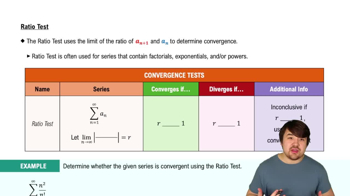
Recall the Ratio Test: For a series \(\sum a_k\), compute the limit \(L = \lim_{k \to \infty} \left| \frac{a_{k+1}}{a_k} \right|\). If \(L < 1\), the series converges absolutely; if \(L > 1\), it diverges; if \(L = 1\), the test is inconclusive.
Compute the ratio \(\frac{a_{k+1}}{a_k} = \frac{\left( \frac{k+1}{k+2} \right) 2^{(k+1)^2}}{\left( \frac{k}{k+1} \right) 2^{k^2}} = \left( \frac{k+1}{k+2} \times \frac{k+1}{k} \right) \times 2^{(k+1)^2 - k^2}\).
Simplify the exponent difference: \((k+1)^2 - k^2 = 2k + 1\), so the ratio becomes \(\left( \frac{(k+1)^2}{k(k+2)} \right) \times 2^{2k+1}\).
Evaluate the limit as \(k \to \infty\) of the ratio. Since \(2^{2k+1}\) grows exponentially, the limit will be infinite, which implies by the Ratio Test that the series diverges.

Risposta video verificata per un problema simile:

Questa soluzione video è stata consigliata dai nostri tutor come utile per risolvere questo problema.
Durata del video:
5m

Concetti chiave

Ecco i concetti essenziali che devi comprendere per rispondere correttamente alla domanda.

Ratio Test

The Ratio Test determines the convergence of an infinite series by examining the limit of the absolute value of the ratio of consecutive terms. If this limit is less than 1, the series converges absolutely; if greater than 1, it diverges; if equal to 1, the test is inconclusive.
Video consigliato:

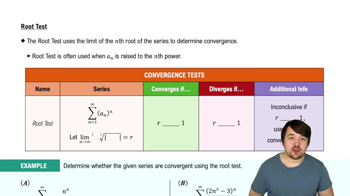
Root Test

The Root Test analyzes convergence by taking the nth root of the absolute value of the nth term of a series. If the limit of this root as n approaches infinity is less than 1, the series converges absolutely; if greater than 1, it diverges; if equal to 1, the test is inconclusive.
Video consigliato:

Absolute Convergence

A series converges absolutely if the series of the absolute values of its terms converges. Absolute convergence guarantees convergence regardless of term signs, making tests like the Ratio and Root Tests effective tools for determining the behavior of series with positive or negative terms.
Video consigliato:
Percorso guidato
07:51
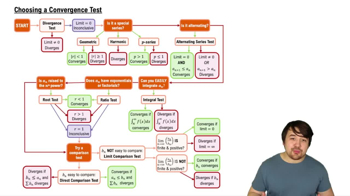
Choosing a Convergence Test