Ch. 10 - Sequences and Infinite Series
Briggs - Calculus: Early Transcendentals 3rd Edition
Briggs3rd EditionCalculus: Early TranscendentalsISBN: 9780136847243Non è quello che usi tu?Cambia libro di testo
Capitolo 10, Problema 10.7.31b

Explain why or why not Determine whether the following statements are true and give an explanation or counterexample.


b. (2n)! / (2n − 1)! = 2n

Guida verificata passo dopo passo
1
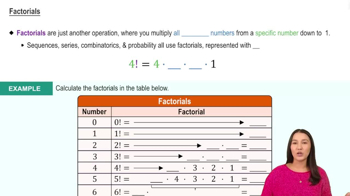
Recall the definition of factorial: for any positive integer \(k\), \(k! = k \times (k-1) \times (k-2) \times \cdots \times 1\).
Write out the factorial expressions explicitly: \((2n)! = (2n) \times (2n - 1) \times (2n - 2) \times \cdots \times 1\) and \((2n - 1)! = (2n - 1) \times (2n - 2) \times \cdots \times 1\).
Set up the fraction and simplify by canceling common terms: \(\frac{(2n)!}{(2n - 1)!} = \frac{(2n) \times (2n - 1) \times \cdots \times 1}{(2n - 1) \times \cdots \times 1} = 2n\).
Conclude that the statement \(\frac{(2n)!}{(2n - 1)!} = 2n\) is true because the factorial terms cancel except for the factor \$2n$ in the numerator.
Therefore, the expression simplifies exactly to \$2n$, confirming the statement is correct.

Risposta video verificata per un problema simile:

Questa soluzione video è stata consigliata dai nostri tutor come utile per risolvere questo problema.
Durata del video:
2m

Concetti chiave

Ecco i concetti essenziali che devi comprendere per rispondere correttamente alla domanda.

Factorials and Their Properties

A factorial, denoted n!, is the product of all positive integers from 1 up to n. Understanding how factorials expand and simplify is essential, especially when dealing with ratios like (2n)! / (2n − 1)!, where many terms cancel out.
Video consigliato:
5:22
Factorials

Simplifying Factorial Expressions

When dividing factorials such as (2n)! by (2n − 1)!, most terms cancel, leaving only the highest term, 2n. This simplification helps determine if the given expression equals 2n or not.
Video consigliato:
5:22
Factorials

Verification Using Counterexamples

To test the truth of a statement involving factorials, substituting specific values of n can confirm or refute it. A single counterexample disproves the statement, while consistent results support its validity.
Video consigliato:
Percorso guidato
08:14
Using The Acceleration Function
Pratica correlata
Domanda del libro di testo

Explain why or why not

Determine whether the following statements are true and give an explanation or counterexample.


b.If a sequence of positive numbers converges, then the sequence is decreasing.

60
views

Domanda del libro di testo

67–70. Formulas for sequences of partial sums Consider the following infinite series.


a.Find the first four partial sums S₁, S₂, S₃, S₄ of the series.


∑⁽∞⁾ₖ₌₁2⁄[(2k − 1)(2k + 1)]

89
views
Domanda del libro di testo

57–60. Heights of bouncing balls A ball is thrown upward to a height of hₒ meters. After each bounce, the ball rebounds to a fraction r of its previous height. Let hₙ be the height after the nth bounce. Consider the following values of hₒ and r.


b. Find an explicit formula for the nth term of the sequence {hₙ}.


h₀ = 20,r = 0.5

82
views
Domanda del libro di testo

87. Explain why or why not

Determine whether the following statements are true and give an explanation or counterexample.


b. If ∑ (k = 1 to ∞) aₖ diverges, then ∑ (k = 10 to ∞) aₖ diverges.

46
views
Domanda del libro di testo

18–20. Evaluating geometric series two ways Evaluate each geometric series two ways.


b. Evaluate the series using Theorem 10.7.


∑ (k = 0 to ∞) (–2/7)ᵏ

79
views
Domanda del libro di testo

39–40. {Use of Tech} Lower and upper bounds of a series

For each convergent series and given value of n, use Theorem 10.13 to complete the following.


b. Find an upper bound for the remainder Rₙ.


39. ∑ (k = 1 to ∞) 1 / k⁷ ; n = 2

120
views