
Ch. 10 - Sequences and Infinite Series
Briggs - Calculus: Early Transcendentals 3rd Edition
Briggs3rd EditionCalculus: Early TranscendentalsISBN: 9780136847243Non è quello che usi tu?Cambia libro di testo
Capitolo 10, Problema 10.6.65c

Explain why or why not Determine whether the following statements are true and give an explanation or counterexample.


c. A series that converges conditionally must converge.

Guida verificata passo dopo passo
1
Recall the definition of conditional convergence: A series \( \sum a_n \) converges conditionally if it converges, but does not converge absolutely. That is, \( \sum a_n \) converges, but \( \sum |a_n| \) diverges.
The statement says: "A series that converges conditionally must converge." By the definition of conditional convergence, the series does converge (but not absolutely). So the statement is true by definition.
To clarify, conditional convergence implies convergence of the original series, but not absolute convergence. This means the series converges, but the sum of the absolute values of its terms does not.
A classic example of a conditionally convergent series is the alternating harmonic series \( \sum_{n=1}^\infty (-1)^{n+1} \frac{1}{n} \), which converges, but the harmonic series \( \sum_{n=1}^\infty \frac{1}{n} \) diverges, so it is not absolutely convergent.
Therefore, the statement is true because conditional convergence by definition requires the series to converge (just not absolutely).

Risposta video verificata per un problema simile:

Questa soluzione video è stata consigliata dai nostri tutor come utile per risolvere questo problema.
Durata del video:
3m

Concetti chiave

Ecco i concetti essenziali che devi comprendere per rispondere correttamente alla domanda.

Conditional Convergence

A series converges conditionally if it converges but does not converge absolutely. This means the series converges when considering the terms with their signs, but the series of absolute values diverges. An example is the alternating harmonic series.
Video consigliato:
Percorso guidato
07:51
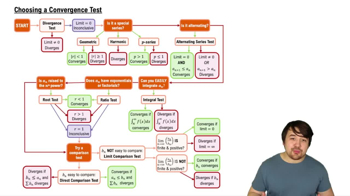
Choosing a Convergence Test

Absolute Convergence

A series converges absolutely if the series of the absolute values of its terms converges. Absolute convergence guarantees convergence of the original series, and it is a stronger form of convergence than conditional convergence.
Video consigliato:
Percorso guidato
07:51
Choosing a Convergence Test

Convergence of Series

A series converges if the sequence of its partial sums approaches a finite limit. Conditional convergence implies the series converges, but not absolutely. Therefore, any conditionally convergent series must converge, but not all convergent series are conditionally convergent.
Video consigliato:
Percorso guidato
06:52
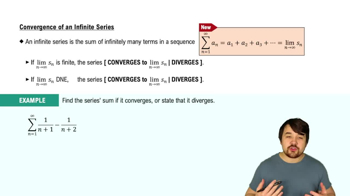
Convergence of an Infinite Series
Pratica correlata
Domanda del libro di testo

{Use of Tech} Drug Dosing

A patient takes 75 mg of a medication every 12 hours; 60% of the medication in the blood is eliminated every 12 hours.


c.Find the limit of the sequence. What is the physical meaning of this limit?

46
views
Domanda del libro di testo

72–75. {Use of Tech} Practical sequences

Consider the following situations that generate a sequence


c.Find a recurrence relation that generates the sequence.


Radioactive decay

A material transmutes 50% of its mass to another element every 10 years due to radioactive decay. Let Mₙ be the mass of the radioactive material at the end of the nᵗʰ decade, where the initial mass of the material is M₀ = 20g.

46
views
Domanda del libro di testo

27–34. Working with sequences Several terms of a sequence {aₙ}ₙ₌₁∞ are given.

c. Find an explicit formula for the nth term of the sequence.


{1, 2, 4, 8, 16, ......}

61
views
Domanda del libro di testo

87. Explain why or why not

Determine whether the following statements are true and give an explanation or counterexample.


c. If ∑ aₖ converges, then ∑ (aₖ + 0.0001) converges.

43
views
Domanda del libro di testo

Explain why or why not Determine whether the following statements are true and give an explanation or counterexample.


c. Suppose f is a continuous, positive, decreasing function, for x ≥ 1, and aₖ = f(k), for k = 1, 2, 3, …. If ∑ (k = 1 to ∞) aₖ converges to L, then ∫ (1 to ∞) f(x) dx converges to L.

63
views
Domanda del libro di testo

41–44. {Use of Tech} Remainders and estimates Consider the following convergent series.


c. Find lower and upper bounds (Lₙ and Uₙ, respectively) on the exact value of the series.


41. ∑ (k = 1 to ∞) 1 / k⁶

93
views