Ch. 10 - Sequences and Infinite Series
Briggs - Calculus: Early Transcendentals 3rd Edition
Briggs3rd EditionCalculus: Early TranscendentalsISBN: 9780136847243Non è quello che usi tu?Cambia libro di testo
Capitolo 10, Problema 10.5.37a

Explain why or why not Determine whether the following statements are true and give an explanation or counterexample.
a. Suppose 0 < aₖ < bₖ. If ∑ (k = 1 to ∞) aₖ converges, then ∑ (k = 1 to ∞) bₖ converges.

Guida verificata passo dopo passo
1
Step 1: Understand the given inequality and series. We have two sequences \(a_k\) and \(b_k\) such that \(0 < a_k < b_k\) for all \(k\), and the series \(\sum_{k=1}^\infty a_k\) converges.
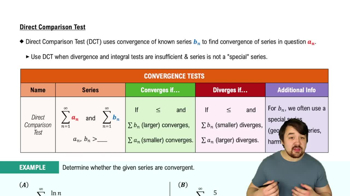
Step 2: Recall the Comparison Test for series convergence. If \(0 \leq a_k \leq b_k\) for all \(k\) and \(\sum b_k\) converges, then \(\sum a_k\) also converges. This test gives a condition for \(a_k\) based on \(b_k\), not the other way around.
Step 3: Analyze the statement: it claims that if \(\sum a_k\) converges and \(a_k < b_k\), then \(\sum b_k\) converges. This is the reverse of the Comparison Test and is generally not true.
Step 4: To disprove the statement, consider a counterexample. For instance, let \(a_k = \frac{1}{k^2}\) which converges, and \(b_k = \frac{1}{k}\) which is larger than \(a_k\) but whose series diverges.
Step 5: Conclude that since \(\sum a_k\) converges but \(\sum b_k\) diverges in this example, the original statement is false.

Risposta video verificata per un problema simile:

Questa soluzione video è stata consigliata dai nostri tutor come utile per risolvere questo problema.
Durata del video:
4m

Concetti chiave

Ecco i concetti essenziali che devi comprendere per rispondere correttamente alla domanda.

Comparison Test for Series

The Comparison Test helps determine the convergence of a series by comparing it to another series with known behavior. If 0 ≤ aₖ ≤ bₖ for all k and ∑ bₖ converges, then ∑ aₖ also converges. However, the converse is not necessarily true.
Video consigliato:
Percorso guidato
09:25
Direct Comparison Test

Convergence of Positive Term Series

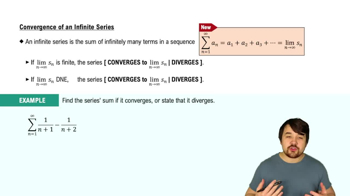
A series with positive terms converges if its partial sums approach a finite limit. Understanding that larger terms can cause divergence is key; thus, if a smaller series converges, a larger one may still diverge.
Video consigliato:
Percorso guidato
06:52
Convergence of an Infinite Series

Counterexamples in Series Convergence

Counterexamples demonstrate why a statement is false by providing a specific case that violates it. For series, showing a convergent smaller series and a divergent larger series disproves the claim that convergence of the smaller implies convergence of the larger.
Video consigliato:
Percorso guidato
06:52
Convergence of an Infinite Series
Pratica correlata
Domanda del libro di testo

71. Evaluating an infinite series two ways

Evaluate the series

∑ (k = 1 to ∞) (4 / 3ᵏ – 4 / 3ᵏ⁺¹) two ways.

a. Use a telescoping series argument.

84
views

Domanda del libro di testo

39–40. {Use of Tech} Lower and upper bounds of a series

For each convergent series and given value of n, use Theorem 10.13 to complete the following.


a. Use Sₙ to estimate the sum of the series.


39. ∑ (k = 1 to ∞) 1 / k⁷ ; n = 2

91
views
Domanda del libro di testo

Explain why or why not

Determine whether the following statements are true and give an explanation or counterexample.

a. If the Limit Comparison Test can be applied successfully to a given series with a certain comparison series, the Comparison Test also works with the same comparison series.

46
views
Domanda del libro di testo

57–60. Heights of bouncing balls A ball is thrown upward to a height of hₒ meters. After each bounce, the ball rebounds to a fraction r of its previous height. Let hₙ be the height after the nth bounce. Consider the following values of hₒ and r.


a. Find the first four terms of the sequence of heights {hₙ}.


h₀ = 20,r = 0.5

52
views
Domanda del libro di testo

Explain why or why not

Determine whether the following statements are true and give an explanation or counterexample.


a.The sequence of partial sums for the series1 + 2 + 3 + ⋯ is {1, 3, 6, 10, …}.

68
views
Domanda del libro di testo

72–75. {Use of Tech} Practical sequences

Consider the following situations that generate a sequence


a.Write out the first five terms of the sequence.


Radioactive decay

A material transmutes 50% of its mass to another element every 10 years due to radioactive decay. Let Mₙ be the mass of the radioactive material at the end of the nᵗʰ decade, where the initial mass of the material is M₀ = 20g.

50
views