Ch. 10 - Sequences and Infinite Series
Briggs - Calculus: Early Transcendentals 3rd Edition
Briggs3rd EditionCalculus: Early TranscendentalsISBN: 9780136847243Non è quello che usi tu?Cambia libro di testo
Capitolo 10, Problema 10.R.1a

Explain why or why not
Determine whether the following statements are true and give an explanation or counterexample.
a.The terms of the sequence {aₙ} increase in magnitude, so the limit of the sequence does not exist.

Guida verificata passo dopo passo
1
First, understand what it means for the terms of a sequence \( \{a_n\} \) to increase in magnitude. This means that the absolute values \( |a_n| \) are getting larger as \( n \) increases.
Recall that a sequence \( \{a_n\} \) converges to a limit \( L \) if and only if the terms get arbitrarily close to \( L \) as \( n \to \infty \). If the magnitude \( |a_n| \) increases without bound, the terms cannot approach a finite limit.
However, consider the possibility that the terms might oscillate or approach zero despite increasing magnitude. For example, if \( a_n = (-1)^n n \), the magnitude increases but the sequence does not converge because it oscillates and grows without bound.
On the other hand, if the magnitude increases but the terms approach zero, this would be a contradiction because the magnitude cannot increase and approach zero simultaneously.
Therefore, if the terms of the sequence increase in magnitude without bound, the sequence does not have a finite limit. This means the statement is true: increasing magnitude implies the limit does not exist.

Risposta video verificata per un problema simile:

Questa soluzione video è stata consigliata dai nostri tutor come utile per risolvere questo problema.
Durata del video:
1m

Concetti chiave

Ecco i concetti essenziali che devi comprendere per rispondere correttamente alla domanda.

Sequence and Limit of a Sequence

A sequence is an ordered list of numbers, and its limit is the value the terms approach as the index goes to infinity. If the terms get closer to a specific number, the sequence converges; otherwise, it diverges. Understanding limits helps determine the behavior of sequences at infinity.
Video consigliato:
8:22
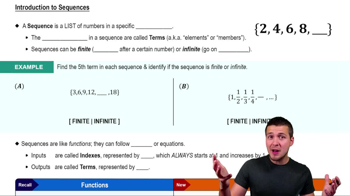
Introduction to Sequences

Magnitude (Absolute Value) of Sequence Terms

The magnitude or absolute value of a term measures its distance from zero, ignoring sign. A sequence can increase in magnitude even if terms alternate in sign. This concept is crucial to analyze whether the terms grow without bound or oscillate.
Video consigliato:
8:22
Introduction to Sequences

Convergence Criteria and Counterexamples

A sequence converges if its terms approach a finite limit. Increasing magnitude often suggests divergence, but exceptions exist. Providing counterexamples, such as sequences with increasing magnitude but convergent behavior, helps test the truth of statements rigorously.
Video consigliato:
Percorso guidato
07:51
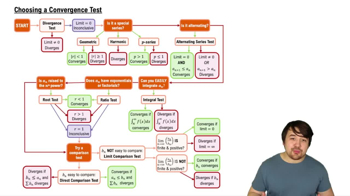
Choosing a Convergence Test