Ch. 10 - Sequences and Infinite Series
Briggs - Calculus: Early Transcendentals 3rd Edition
Briggs3rd EditionCalculus: Early TranscendentalsISBN: 9780136847243Non è quello che usi tu?Cambia libro di testo
Capitolo 10, Problema 10.6.3

Why does the value of a converging alternating series with terms that are nonincreasing in magnitude lie between any two consecutive terms of its sequence of partial sums?

Guida verificata passo dopo passo
1
Recall the Alternating Series Test, which states that if the terms of an alternating series decrease in magnitude to zero, then the series converges.
Understand that the sequence of partial sums of such a series alternates above and below the actual sum because each new term added changes the partial sum by a smaller and smaller amount, switching signs each time.
Note that since the terms are nonincreasing in magnitude, the difference between consecutive partial sums decreases, causing the partial sums to 'trap' the true sum between them.
Recognize that this trapping means the true sum lies between any two consecutive partial sums, because the partial sums form an alternating sequence converging to the sum from above and below.
Conclude that this property ensures the value of the converging alternating series is always bounded between any two consecutive partial sums, providing a natural error bound for approximations.

Risposta video verificata per un problema simile:

Questa soluzione video è stata consigliata dai nostri tutor come utile per risolvere questo problema.
Durata del video:
2m

Concetti chiave

Ecco i concetti essenziali che devi comprendere per rispondere correttamente alla domanda.

Alternating Series

An alternating series is a series whose terms alternate in sign, typically written as positive and negative terms in succession. This pattern affects the behavior of partial sums, causing them to oscillate above and below the series' limit, which is key to understanding convergence properties.
Video consigliato:
Percorso guidato
06:00
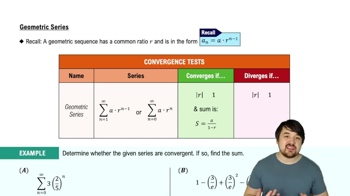
Geometric Series

Monotone Decreasing Terms in Magnitude

When the absolute values of the terms in a series decrease monotonically (each term is smaller or equal in magnitude than the previous), it ensures the partial sums approach the limit in a controlled manner. This condition is crucial for applying the Alternating Series Test and for bounding the error between partial sums and the series sum.
Video consigliato:
Percorso guidato
05:44
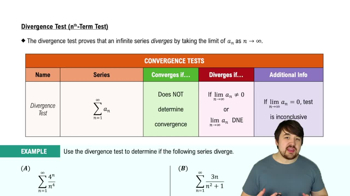
Divergence Test (nth Term Test)

Partial Sums and Convergence Bounds

Partial sums are the sums of the first n terms of a series. For converging alternating series with decreasing term magnitudes, the sequence of partial sums alternates around the limit, meaning the true sum lies between any two consecutive partial sums. This property provides a natural bound on the approximation error.
Video consigliato:
Percorso guidato
08:01
Integration Using Partial Fractions