Ch. 11 - Power Series
Briggs - Calculus: Early Transcendentals 3rd Edition
Briggs3rd EditionCalculus: Early TranscendentalsISBN: 9780136847243Non è quello che usi tu?Cambia libro di testo
Capitolo 11, Problema 11.4.69

A limit by Taylor series Use Taylor series to evaluate lim ₓ→₀ ((sin x)/x)¹/ˣ²

Guida verificata passo dopo passo
1
Recognize that the limit is of the form \(\lim_{x \to 0} \left( \frac{\sin x}{x} \right)^{\frac{1}{x^2}}\). Since direct substitution leads to an indeterminate form, we use the Taylor series expansion to simplify the expression inside the limit.
Recall the Taylor series expansion of \(\sin x\) around \(x=0\): \(\sin x = x - \frac{x^3}{3!} + \frac{x^5}{5!} - \cdots\). Substitute this into the expression \(\frac{\sin x}{x}\) to get \(\frac{\sin x}{x} = 1 - \frac{x^2}{6} + \frac{x^4}{120} - \cdots\).
Rewrite the original limit as \(\lim_{x \to 0} \left( 1 - \frac{x^2}{6} + \cdots \right)^{\frac{1}{x^2}}\). This is a limit of the form \(\left(1 + f(x)\right)^{g(x)}\) where \(f(x) \to 0\) and \(g(x) \to \infty\) as \(x \to 0\).
Use the fact that \(\lim_{x \to 0} (1 + f(x))^{g(x)} = e^{\lim_{x \to 0} f(x) g(x)}\) if the latter limit exists. Here, identify \(f(x) = -\frac{x^2}{6} + \cdots\) and \(g(x) = \frac{1}{x^2}\).
Calculate the exponent limit: \(\lim_{x \to 0} f(x) g(x) = \lim_{x \to 0} \left(-\frac{x^2}{6} + \cdots \right) \cdot \frac{1}{x^2}\). Simplify this expression to find the exponent of \(e\), which will give the value of the original limit.

Risposta video verificata per un problema simile:

Questa soluzione video è stata consigliata dai nostri tutor come utile per risolvere questo problema.
Durata del video:
4m

Concetti chiave

Ecco i concetti essenziali che devi comprendere per rispondere correttamente alla domanda.

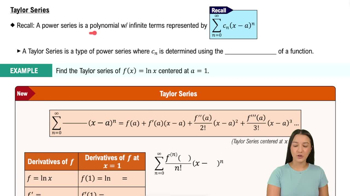
Taylor Series Expansion

A Taylor series represents a function as an infinite sum of terms calculated from the function's derivatives at a single point. For functions like sin(x), the series expansion around x=0 helps approximate values near zero, making it easier to analyze limits involving complex expressions.
Video consigliato:
08:42
Taylor Series

Limits Involving Indeterminate Forms

Limits that result in forms like 0^∞ or 1^∞ are indeterminate and require special techniques to evaluate. Using series expansions or logarithmic transformations can simplify these expressions, allowing the limit to be computed accurately.
Video consigliato:
07:01
Integrals Involving Natural Logs: Substitution

Exponential and Logarithmic Manipulation of Limits

When limits involve expressions raised to powers that approach zero or infinity, rewriting the expression using logarithms and exponentials helps. Taking the natural logarithm transforms the power into a product, simplifying the limit evaluation before exponentiating back to find the original limit.
Video consigliato:
5:02
Solving Logarithmic Equations