
Ch. 11 - Power Series
Briggs - Calculus: Early Transcendentals 3rd Edition
Briggs3rd EditionCalculus: Early TranscendentalsISBN: 9780136847243Non è quello che usi tu?Cambia libro di testo
Capitolo 11, Problema 11.2.67c

Explain why or why not Determine whether the following statements are true and give an explanation or counterexample.
c. If f has a Taylor series that converges only on (−2,2), then f(x²) has a Taylor series that also converges only on (−2,2).

Guida verificata passo dopo passo
1
Recall that the radius of convergence of a Taylor series centered at 0 is the distance from 0 to the nearest singularity of the function in the complex plane.
Given that the Taylor series of \( f \) converges only on the interval \( (-2, 2) \), this means the radius of convergence \( R \) of \( f \) is 2.
Now consider the function \( g(x) = f(x^2) \). To find the radius of convergence of the Taylor series of \( g \), analyze how the substitution \( x^2 \) affects the domain.
Since \( g(x) = f(x^2) \), the series for \( g \) converges when \( |x^2| < 2 \), which simplifies to \( |x| < \sqrt{2} \).
Therefore, the radius of convergence of the Taylor series for \( g(x) \) is \( \sqrt{2} \), which is different from the original radius 2, so the statement is false.

Risposta video verificata per un problema simile:

Questa soluzione video è stata consigliata dai nostri tutor come utile per risolvere questo problema.
Durata del video:
2m

Concetti chiave

Ecco i concetti essenziali che devi comprendere per rispondere correttamente alla domanda.

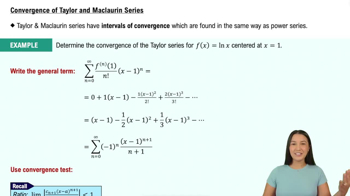
Radius of Convergence of a Taylor Series

The radius of convergence is the distance from the center point within which a Taylor series converges to the function. It depends on the function's behavior and singularities in the complex plane. Understanding this helps determine where the series representation is valid.
Video consigliato:
08:26
Convergence of Taylor & Maclaurin Series

Composition of Functions and Its Effect on Convergence

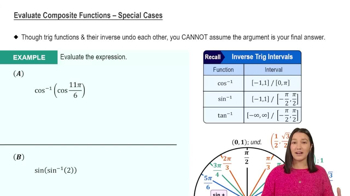
When composing functions, such as considering f(x²), the domain and convergence properties can change. The substitution x² affects the input range and may alter the radius of convergence of the resulting Taylor series.
Video consigliato:
3:48
Evaluate Composite Functions - Special Cases

Counterexamples in Analysis

Counterexamples demonstrate that a general statement is false by providing a specific case where it fails. Constructing or identifying counterexamples is crucial to test claims about convergence and function behavior rigorously.
Video consigliato:
Percorso guidato
06:29
Derivatives Applied To Velocity
Pratica correlata
Domanda del libro di testo

Explain why or why not Determine whether the following statements are true and give an explanation or counterexample.


c. Only even powers of x appear in the nth−order Taylor polynomial for f(x)=√(1+x²) centered at 0.

59
views
Domanda del libro di testo

Explain why or why not Determine whether the following statements are true and give an explanation or counterexample.

d. Suppose f'' is continuous on an interval that contains a, where f has an inflection point at a. Then the second−order Taylor polynomial for f at a is linear.

49
views
Domanda del libro di testo

{Use of Tech} Bessel functions Bessel functions arise in the study of wave propagation in circular geometries (for example, waves on a circular drum head). They are conveniently defined as power series. One of an infinite family of Bessel functions is

J₀(x) = ∑ₖ₌₀∞ (−1)ᵏ/(2²ᵏ(k!)²) x²ᵏ

c. Differentiate J₀ twice and show (by keeping terms through x⁶) that J₀ satisfies the equation x² y′′(x) + xy′(x) + x²y(x)=0.

54
views
Domanda del libro di testo

Taylor series and interval of convergence


c. Determine the interval of convergence of the series.


f(x)=2/(1−x)³, a=0

43
views
Domanda del libro di testo

Matching functions with polynomials Match functions a–f with Taylor polynomials A–F (all centered at 0). Give reasons for your choices.


d. 1/(1 + 2x)


A. p₂(x)= 1 + 2x + 2x²

B. p₂(x) = 1 − 6x + 24x²

C. p₂(x) = 1 + x − x²/2

D. p₂(x) = 1 − 2x + 4x²

E. p₂(x) = 1 − x + (3/2)x²

F. p₂(x) = 1 − 2x + 2x²

30
views
Domanda del libro di testo

Explain why or why not Determine whether the following statements are true and give an explanation or counterexample.


If f(x)=∑ₖ₌₀∞ cₖ xᵏ=0, for all x on an interval (−a, a), then cₖ = 0, for all k.

62
views