
Ch. 11 - Power Series
Briggs - Calculus: Early Transcendentals 3rd Edition
Briggs3rd EditionCalculus: Early TranscendentalsISBN: 9780136847243Non è quello che usi tu?Cambia libro di testo
Capitolo 11, Problema 11.3.3

Find a Taylor series for f centered at 2 given that f⁽ᵏ⁾(2)=1, for all nonnegative integers k.

Guida verificata passo dopo passo
1
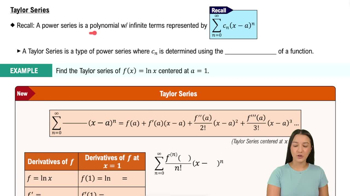
Recall the general formula for the Taylor series of a function \(f\) centered at \(a\): \[f(x) = \sum_{k=0}^{\infty} \frac{f^{(k)}(a)}{k!} (x - a)^k,\] where \(f^{(k)}(a)\) is the \(k\)-th derivative of \(f\) evaluated at \(a\).
In this problem, the center is \(a = 2\), and we are given that for all nonnegative integers \(k\), \[f^{(k)}(2) = 1.\]
Substitute the given derivative values into the Taylor series formula: \[f(x) = \sum_{k=0}^{\infty} \frac{1}{k!} (x - 2)^k.\]
Recognize that this series matches the expansion of the exponential function \(e^y = \sum_{k=0}^{\infty} \frac{y^k}{k!}\), where \(y = x - 2\).
Therefore, the Taylor series for \(f\) centered at 2 can be expressed as \[f(x) = \sum_{k=0}^{\infty} \frac{(x - 2)^k}{k!}.\] This is the series representation of \(e^{x-2}\), but since the problem only asks for the Taylor series, this summation form is the key result.

Risposta video verificata per un problema simile:

Questa soluzione video è stata consigliata dai nostri tutor come utile per risolvere questo problema.
Durata del video:
1m

Concetti chiave

Ecco i concetti essenziali che devi comprendere per rispondere correttamente alla domanda.

Taylor Series Expansion

A Taylor series represents a function as an infinite sum of terms calculated from the derivatives of the function at a single point. Centered at a point a, it approximates the function near a using powers of (x - a) weighted by the function's derivatives at a.
Video consigliato:
08:42
Taylor Series

Derivatives and Their Role in Taylor Series

The coefficients of a Taylor series are determined by the function's derivatives at the center point. Specifically, the k-th term involves the k-th derivative evaluated at the center, divided by k factorial, multiplied by (x - a)^k.
Video consigliato:
08:42
Taylor Series

Factorials and Series Coefficients

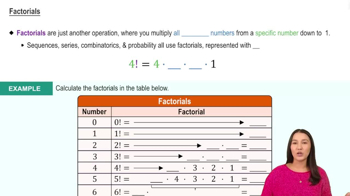
Factorials (k!) appear in the denominator of each Taylor series term to normalize the contribution of the k-th derivative. This ensures the series converges properly and accurately represents the function near the center.
Video consigliato:
5:22
Factorials
Pratica correlata
Domanda del libro di testo

Use of Tech Linear and quadratic approximation


a. Find the linear approximating polynomial for the following functions centered at the given point a.


b. Find the quadratic approximating polynomial for the following functions centered at a.


c Use the polynomials obtained in parts (a) and (b) to approximate the given quantity.


f(x) = 8x^(3/2), a=1; approximate 8 ⋅ 1.1^(3/2)

78
views
Domanda del libro di testo

Taylor series Write out the first three nonzero terms of the Taylor series for the following functions centered at the given point a. Then write the series using summation notation.

ƒ(x) = tan⁻¹(4x), a = 0

70
views
Domanda del libro di testo

{Use of Tech} Approximating definite integrals Use a Taylor series to approximate the following definite integrals. Retain as many terms as needed to ensure the error is less than 10⁻⁴.

∫₀⁰ᐧ² sin x² dx

68
views
Domanda del libro di testo

Use of Tech Linear and quadratic approximation


a. Find the linear approximating polynomial for the following functions centered at the given point a.


b. Find the quadratic approximating polynomial for the following functions centered at a.


c Use the polynomials obtained in parts (a) and (b) to approximate the given quantity.


Find the Taylor polynomials p₁, …, p₅ centered at a=0 for f(x)=e⁻ˣ

37
views
Domanda del libro di testo

Derivative trick Here is an alternative way to evaluate higher derivatives of a function f that may save time. Suppose you can find the Taylor series for f centered at the point a without evaluating derivatives (for example, from a known series). Then f⁽ᵏ⁾(a)=k! multiplied by the coefficient of (x−a)ᵏ. Use this idea to evaluate f⁽³⁾(0) and f⁽⁴⁾(0) for the following functions. Use known series and do not evaluate derivatives.


f(x) = eᶜᵒˢ ˣ

107
views
Domanda del libro di testo

Radius and interval of convergence Determine the radius and interval of convergence of the following power series.


∑ₖ₌₂∞ ((x+3)ᵏ)/(k łn²k)

46
views