
Domanda del libro di testo
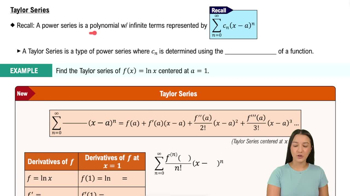
Suppose the power series ∑ₖ₌₀∞ cₖ(x−a)ᵏ has an interval of convergence of (−3,7]. Find the center a and the radius of convergence R.
40
views

 Guida verificata passo dopo passo
 08:42
08:42
 6:37
6:37 06:52
06:52Suppose the power series ∑ₖ₌₀∞ cₖ(x−a)ᵏ has an interval of convergence of (−3,7]. Find the center a and the radius of convergence R.
Working with binomial series Use properties of power series, substitution, and factoring to find the first four nonzero terms of the Maclaurin series for the following functions. Give the interval of convergence for the new series (Theorem 11.4 is useful). Use the Maclaurin series
√(1 + x) = 1 + x/2 − x²/8 + x³/16 − ⋯, −1 ≤ x ≤ 1.
√(9 − 9x)
The first three Taylor polynomials for f(x)=√(1+x) centered at 0 are p₀ = 1, p₁ = 1+x/2, and p₂ = 1 + x/2 − x²/8. Find three approximations to √1.1.
{Use of Tech} Maximum error Use the remainder term to find a bound on the error in the following approximations on the given interval. Error bounds are not unique.
sin x ≈ x − x³/6 on [π/4, π/4]
Manipulating Taylor series Use the Taylor series in Table 11.5 to find the first four nonzero terms of the Taylor series for the following functions centered at 0.
{(eˣ−1)/x if x ≠ 1, 1 if x = 1