Ch. 11 - Power Series
Briggs - Calculus: Early Transcendentals 3rd Edition
Briggs3rd EditionCalculus: Early TranscendentalsISBN: 9780136847243Non è quello che usi tu?Cambia libro di testo
Capitolo 11, Problema 11.4.11

Limits Evaluate the following limits using Taylor series.
lim ₓ→₀ (eˣ − e⁻ˣ)/x

Guida verificata passo dopo passo
1
Recall the Taylor series expansions of the exponential functions around 0: \(e^{x} = 1 + x + \frac{x^{2}}{2!} + \frac{x^{3}}{3!} + \cdots\) and \(e^{-x} = 1 - x + \frac{x^{2}}{2!} - \frac{x^{3}}{3!} + \cdots\).
Substitute these expansions into the expression \(\frac{e^{x} - e^{-x}}{x}\) to get \(\frac{\left(1 + x + \frac{x^{2}}{2!} + \frac{x^{3}}{3!} + \cdots\right) - \left(1 - x + \frac{x^{2}}{2!} - \frac{x^{3}}{3!} + \cdots\right)}{x}\).
Simplify the numerator by combining like terms: the constant terms cancel out, and you combine the \(x\) terms, \(x^{2}\) terms, etc., carefully noting the signs.
After simplification, factor out \(x\) from the numerator to cancel with the denominator, which will help in evaluating the limit as \(x\) approaches 0.
Evaluate the resulting expression by substituting \(x = 0\) into the simplified series to find the limit.

Risposta video verificata per un problema simile:

Questa soluzione video è stata consigliata dai nostri tutor come utile per risolvere questo problema.
Durata del video:
4m

Concetti chiave

Ecco i concetti essenziali che devi comprendere per rispondere correttamente alla domanda.

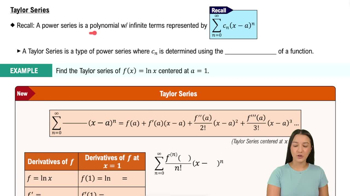
Taylor Series Expansion

A Taylor series represents a function as an infinite sum of terms calculated from the function's derivatives at a single point. It approximates functions near that point, allowing complex expressions to be simplified into polynomials. For example, eˣ can be expanded around x=0 as 1 + x + x²/2! + x³/3! + ....
Video consigliato:
08:42
Taylor Series

Limit Evaluation Using Series

When direct substitution in a limit leads to an indeterminate form, expanding functions into their Taylor series can simplify the expression. By substituting series expansions, terms can often be canceled or simplified, making it easier to find the limit as x approaches a point.
Video consigliato:
Percorso guidato
06:00
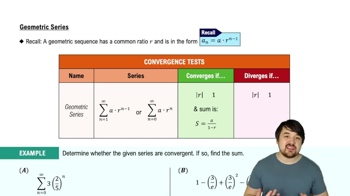
Geometric Series

Hyperbolic Sine Function and Its Relation

The expression (eˣ − e⁻ˣ)/2 defines the hyperbolic sine function, sinh(x). Recognizing this helps simplify the limit problem since (eˣ − e⁻ˣ)/x = 2 * (sinh(x)/x). Understanding sinh(x) and its series expansion aids in evaluating limits involving exponential differences.
Video consigliato:
Percorso guidato
5:20
Relations and Functions
Pratica correlata
Domanda del libro di testo

Remainders Find the remainder Rₙ for the nth−order Taylor polynomial centered at a for the given functions. Express the result for a general value of n.


f(x) = e⁻ˣ, a = 0

76
views

Domanda del libro di testo

Use of Tech Linear and quadratic approximation


a. Find the linear approximating polynomial for the following functions centered at the given point a.


b. Find the quadratic approximating polynomial for the following functions centered at a.


c Use the polynomials obtained in parts (a) and (b) to approximate the given quantity.


Find the Taylor polynomials p₁, p₂, and p₃ centered at a=1 for f(x)=x³.

55
views
Domanda del libro di testo

Representing functions by power series Identify the functions represented by the following power series.

∑ₖ₌₁∞ (x²ᵏ)/k

84
views
Domanda del libro di testo

{Use of Tech} Remainders Let 


f(x) = ∑ₖ₌₀∞ xᵏ = 1/(1−x) and Sₙ(x) = ∑ₖ₌₀ⁿ⁻¹ xᵏ


The remainder in truncating the power series after n terms is Rₙ = f(x) − Sₙ(x), which depends on x.


a. Show that Rₙ(x) = xⁿ /(1−x).

b. Graph the remainder function on the interval |x| < 1, for n=1, 2, and 3 . Discuss and interpret the graph. Where on the interval is |Rₙ(x)| largest? Smallest?

c. For fixed n, minimize |Rₙ(x)| with respect to x. Does the result agree with the observations in part (b)?

d. Let N(x) be the number of terms required to reduce |Rₙ(x)| to less than 10⁻⁶. Graph the function N(x) on the interval |x|<1.

45
views
Domanda del libro di testo

{Use of Tech} Graphing Taylor polynomials


a. Find the nth-order Taylor polynomials for the following functions centered at the given point a, for n=1 and n=2.


b. Graph the Taylor polynomials and the function.


f(x)=sin x, a=π/4

61
views
Domanda del libro di testo

Combining power series Use the geometric series


f(x) = 1/(1-x) = ∑ₖ₌₀∞ xᵏ, for |x| < 1,


to find the power series representation for the following functions (centered at 0). Give the interval of convergence of the new series.


g(x) = x³/(1 − x)

76
views