
Ch. 11 - Power Series
Briggs - Calculus: Early Transcendentals 3rd Edition
Briggs3rd EditionCalculus: Early TranscendentalsISBN: 9780136847243Non è quello che usi tu?Cambia libro di testo
Capitolo 11, Problema 11.3.25a

Taylor series and interval of convergence


a. Use the definition of a Taylor/Maclaurin series to find the first four nonzero terms of the Taylor series for the given function centered at a.


f(x) = ln (x − 2), a = 3

Guida verificata passo dopo passo
1
Recall the definition of the Taylor series of a function \(f(x)\) centered at \(a\): \[f(x) = \sum_{n=0}^{\infty} \frac{f^{(n)}(a)}{n!} (x - a)^n,\] where \(f^{(n)}(a)\) is the \(n\)-th derivative of \(f\) evaluated at \(x = a\).
Identify the function and center: here, \(f(x) = \ln(x - 2)\) and the center is \(a = 3\). We will find derivatives of \(f\) at \(x=3\).
Compute the first derivative: \[f'(x) = \frac{1}{x - 2}.\] Evaluate at \(x=3\): \[f'(3) = \frac{1}{3 - 2} = 1.\]
Find higher order derivatives by differentiating repeatedly: - Second derivative: \[f''(x) = -\frac{1}{(x - 2)^2}\] Evaluate at \(x=3\): \[f''(3) = -1.\] - Third derivative: \[f^{(3)}(x) = \frac{2}{(x - 2)^3}\] Evaluate at \(x=3\): \[f^{(3)}(3) = 2.\] - Fourth derivative: \[f^{(4)}(x) = -\frac{6}{(x - 2)^4}\] Evaluate at \(x=3\): \[f^{(4)}(3) = -6.\]
Write the first four nonzero terms of the Taylor series using the formula: \[f(x) \approx f(3) + f'(3)(x - 3) + \frac{f''(3)}{2!}(x - 3)^2 + \frac{f^{(3)}(3)}{3!}(x - 3)^3 + \frac{f^{(4)}(3)}{4!}(x - 3)^4.\] Substitute the values found for \(f(3)\) and the derivatives to express the series up to the fourth term.

Risposta video verificata per un problema simile:

Questa soluzione video è stata consigliata dai nostri tutor come utile per risolvere questo problema.
Durata del video:
7m

Concetti chiave

Ecco i concetti essenziali che devi comprendere per rispondere correttamente alla domanda.

Taylor and Maclaurin Series

A Taylor series represents a function as an infinite sum of terms calculated from the derivatives of the function at a single point a. When a = 0, it is called a Maclaurin series. Each term involves the nth derivative evaluated at a, multiplied by (x - a)^n and divided by n!. This series approximates the function near the point a.
Video consigliato:
08:26
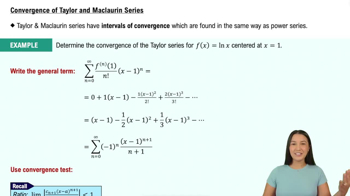
Convergence of Taylor & Maclaurin Series

Derivatives of Logarithmic Functions

To find the Taylor series of f(x) = ln(x - 2), you need to compute successive derivatives of the logarithmic function. The first derivative is 1/(x - 2), and higher derivatives involve powers of (x - 2) in the denominator with alternating signs. Understanding these derivatives is essential to form the terms of the series.
Video consigliato:
05:18
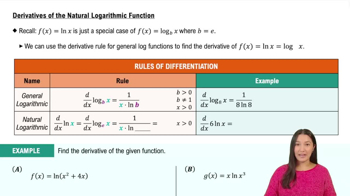
Derivative of the Natural Logarithmic Function

Interval of Convergence

The interval of convergence is the range of x-values for which the Taylor series converges to the function. For ln(x - 2) centered at a = 3, the series converges where |x - 3| is less than the distance to the nearest singularity (x = 2). Determining this interval ensures the series accurately represents the function.
Video consigliato:
08:44
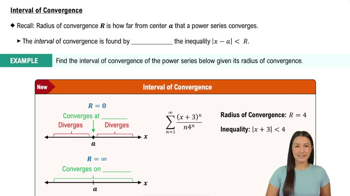
Interval of Convergence
Pratica correlata
Domanda del libro di testo

Probability: sudden−death playoff Teams A and B go into suddendeath overtime after playing to a tie. The teams alternate possession of the ball, and the first team to score wins. Assume each team has a 1/6 chance of scoring when it has the ball, and Team A has the ball first.


b. The expected number of rounds (possessions by either team) required for the overtime to end is (1/6) ∑ₖ₌₁∞ k(5/6)ᵏ⁻¹. Evaluate this series.

61
views
Domanda del libro di testo

Taylor series and interval of convergence


b. Write the power series using summation notation.


f(x) = e²ˣ, a = 0

41
views
Domanda del libro di testo

Taylor series


a. Use the definition of a Taylor series to find the first four nonzero terms of the Taylor series for the given function centered at a.


f(x) = ln x, a = 3

42
views
Domanda del libro di testo

Taylor series and interval of convergence


a. Use the definition of a Taylor/Maclaurin series to find the first four nonzero terms of the Taylor series for the given function centered at a.


f(x) = (1 + x²)⁻¹, a = 0

87
views
Domanda del libro di testo

Explain why or why not Determine whether the following statements are true and give an explanation or counterexample.

The interval of convergence of the power series ∑ cₖ(x−3)ᵏ could be (−2,8).

46
views
Domanda del libro di testo

Sine integral function The function Si(x) = ∫₀ˣ f(t) dt, where f(t) = {(sin t)/t if t ≠ 0, 1 if t = 0, is called the sine integral function.

b. Integrate the series to find a Taylor series for Si.

120
views