Ch. 11 - Power Series
Briggs - Calculus: Early Transcendentals 3rd Edition
Briggs3rd EditionCalculus: Early TranscendentalsISBN: 9780136847243Non è quello che usi tu?Cambia libro di testo
Capitolo 11, Problema 11.3.23c

Taylor series and interval of convergence


c. Determine the interval of convergence of the series.


f(x) = cosh 3x, a = 0

Guida verificata passo dopo passo
1
Recall that the Taylor series expansion of \(f(x) = \cosh(3x)\) about \(a = 0\) can be found by using the known series for \(\cosh x\), which is \(\cosh x = \sum_{n=0}^{\infty} \frac{x^{2n}}{(2n)!}\). Replace \(x\) by \$3x$ to write the series for \(\cosh(3x)\) as \(\sum_{n=0}^{\infty} \frac{(3x)^{2n}}{(2n)!}\).
Express the series explicitly as \(\sum_{n=0}^{\infty} \frac{3^{2n} x^{2n}}{(2n)!}\). This is the Taylor series centered at \(a=0\) for \(f(x)\).
To determine the interval of convergence, apply the Ratio Test to the general term \(a_n = \frac{3^{2n} x^{2n}}{(2n)!}\). Compute the limit \(L = \lim_{n \to \infty} \left| \frac{a_{n+1}}{a_n} \right|\).
Simplify the ratio inside the limit: \(\left| \frac{3^{2(n+1)} x^{2(n+1)}}{(2(n+1))!} \cdot \frac{(2n)!}{3^{2n} x^{2n}} \right| = \left| \frac{3^{2} x^{2}}{(2n+2)(2n+1)} \right|\). Then evaluate the limit as \(n \to \infty\).
Since the factorial in the denominator grows faster than any polynomial, the limit \(L\) approaches zero for all real \(x\). Therefore, the series converges for all real numbers, and the interval of convergence is \((-\infty, \infty)\).

Risposta video verificata per un problema simile:

Questa soluzione video è stata consigliata dai nostri tutor come utile per risolvere questo problema.
Durata del video:
4m

Concetti chiave

Ecco i concetti essenziali che devi comprendere per rispondere correttamente alla domanda.

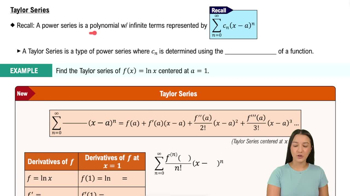
Taylor Series Expansion

A Taylor series represents a function as an infinite sum of terms calculated from the derivatives at a single point. For f(x) centered at a, the series is ∑ (f⁽ⁿ⁾(a)/n!) (x - a)ⁿ. It approximates functions like cosh(3x) using polynomial terms around a = 0.
Video consigliato:
08:42
Taylor Series

Interval of Convergence

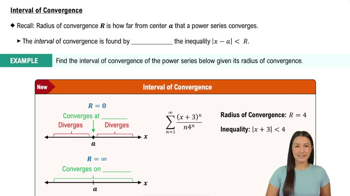
The interval of convergence is the set of x-values for which the Taylor series converges to the function. It is found by applying convergence tests (like the ratio test) to the series terms, determining where the infinite sum is valid and accurately represents the function.
Video consigliato:
08:44
Interval of Convergence

Hyperbolic Cosine Function (cosh x)

The hyperbolic cosine function, cosh x, is defined as (eˣ + e⁻ˣ)/2 and is an even, smooth function. Its Taylor series at 0 includes only even powers of x with positive coefficients, which helps in forming the series for cosh(3x) by substituting 3x into the expansion.
Video consigliato:
Percorso guidato
5:53
Graph of Sine and Cosine Function
Pratica correlata
Domanda del libro di testo

Taylor series and interval of convergence


c. Determine the interval of convergence of the series.


f(x) = 1/x², a=1

73
views

Domanda del libro di testo

Explain why or why not Determine whether the following statements are true and give an explanation or counterexample.


c. Only even powers of x appear in the nth−order Taylor polynomial for f(x)=√(1+x²) centered at 0.

59
views
Domanda del libro di testo

{Use of Tech} Bessel functions Bessel functions arise in the study of wave propagation in circular geometries (for example, waves on a circular drum head). They are conveniently defined as power series. One of an infinite family of Bessel functions is

J₀(x) = ∑ₖ₌₀∞ (−1)ᵏ/(2²ᵏ(k!)²) x²ᵏ

c. Differentiate J₀ twice and show (by keeping terms through x⁶) that J₀ satisfies the equation x² y′′(x) + xy′(x) + x²y(x)=0.

54
views
Domanda del libro di testo

Sine integral function The function Si(x) = ∫₀ˣ f(t) dt, where f(t) = {(sin t)/t if t ≠ 0, 1 if t = 0, is called the sine integral function.

c. Approximate Si(0.5) and Si(1). Use enough terms of the series so the error in the approximation does not exceed 10⁻³.

95
views
Domanda del libro di testo

{Use of Tech} Fresnel integrals The theory of optics gives rise to the two Fresnel integrals

S(x) = ∫₀ˣ sin t² dt and C(x) = ∫₀ˣ cos t² dt

c. Use the polynomials in part (b) to approximate S(0.05) and C(−0.25).

93
views
Domanda del libro di testo

Taylor series and interval of convergence


c. Determine the interval of convergence of the series.


f(x) = e⁻ˣ, a=0

48
views