Ch. 11 - Power Series
Briggs - Calculus: Early Transcendentals 3rd Edition
Briggs3rd EditionCalculus: Early TranscendentalsISBN: 9780136847243Non è quello che usi tu?Cambia libro di testo
Capitolo 11, Problema 11.3.27a

Taylor series


a. Use the definition of a Taylor series to find the first four nonzero terms of the Taylor series for the given function centered at a.


f(x)=sin x, a = π/2

Guida verificata passo dopo passo
1
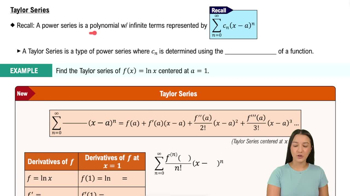
Recall the definition of the Taylor series of a function \(f(x)\) centered at \(a\): \[f(x) = \sum_{n=0}^{\infty} \frac{f^{(n)}(a)}{n!} (x - a)^n,\] where \(f^{(n)}(a)\) is the \(n\)-th derivative of \(f\) evaluated at \(x = a\).
Identify the function and center: here, \(f(x) = \sin x\) and \(a = \frac{\pi}{2}\). We will need to compute the derivatives of \(\sin x\) and evaluate them at \(x = \frac{\pi}{2}\).
Calculate the first four derivatives of \(f(x) = \sin x\): - \(f(x) = \sin x\) - \(f'(x) = \cos x\) - \(f''(x) = -\sin x\) - \(f^{(3)}(x) = -\cos x\) - \(f^{(4)}(x) = \sin x\) (which repeats the cycle).
Evaluate each derivative at \(x = \frac{\pi}{2}\): - \(f\left(\frac{\pi}{2}\right) = \sin \frac{\pi}{2} = 1\) - \(f'\left(\frac{\pi}{2}\right) = \cos \frac{\pi}{2} = 0\) - \(f''\left(\frac{\pi}{2}\right) = -\sin \frac{\pi}{2} = -1\) - \(f^{(3)}\left(\frac{\pi}{2}\right) = -\cos \frac{\pi}{2} = 0\)
Write the first four nonzero terms of the Taylor series using the formula: \[f(x) \approx f(a) + \frac{f'(a)}{1!}(x - a) + \frac{f''(a)}{2!}(x - a)^2 + \frac{f^{(3)}(a)}{3!}(x - a)^3 + \cdots\] Substitute the values found and simplify, including only the nonzero terms.

Risposta video verificata per un problema simile:

Questa soluzione video è stata consigliata dai nostri tutor come utile per risolvere questo problema.
Durata del video:
4m

Concetti chiave

Ecco i concetti essenziali che devi comprendere per rispondere correttamente alla domanda.

Taylor Series Definition

A Taylor series represents a function as an infinite sum of terms calculated from the derivatives of the function at a single point. Each term involves the nth derivative evaluated at the center point, multiplied by (x - a)^n and divided by n!. This series approximates the function near the point a.
Video consigliato:
08:42
Taylor Series

Derivatives of sin(x)

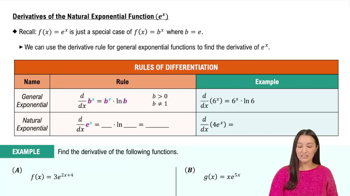
To find the Taylor series of sin(x), you need to compute its derivatives at the center point. The derivatives of sin(x) cycle every four steps: sin(x), cos(x), -sin(x), -cos(x), then back to sin(x). Evaluating these at x = π/2 helps determine the coefficients of the series.
Video consigliato:
04:56
Derivative of the Natural Exponential Function (e^x)

Centering the Series at a = π/2

Centering the Taylor series at a = π/2 means expanding the function around this point, so terms involve powers of (x - π/2). This shifts the approximation focus to values of x near π/2, requiring evaluation of derivatives specifically at π/2 to find accurate coefficients.
Video consigliato:
Percorso guidato
06:00
Geometric Series
Pratica correlata
Domanda del libro di testo

Taylor series


a. Use the definition of a Taylor series to find the first four nonzero terms of the Taylor series for the given function centered at a.


f(x) = 1/x, a = 1

59
views

Domanda del libro di testo

Taylor series and interval of convergence


a. Use the definition of a Taylor/Maclaurin series to find the first four nonzero terms of the Taylor series for the given function centered at a.


f(x) = e²ˣ, a = 0

37
views
Domanda del libro di testo

{Use of Tech} Bessel functions Bessel functions arise in the study of wave propagation in circular geometries (for example, waves on a circular drum head). They are conveniently defined as power series. One of an infinite family of Bessel functions is

J₀(x) = ∑ₖ₌₀∞ (−1)ᵏ/(2²ᵏ(k!)²) x²ᵏ

a. Write out the first four terms of J₀.

61
views
Domanda del libro di testo

Taylor series and interval of convergence


a. Use the definition of a Taylor/Maclaurin series to find the first four nonzero terms of the Taylor series for the given function centered at a.


f(x) = (1 + x²)⁻¹, a = 0

87
views
Domanda del libro di testo

Explain why or why not Determine whether the following statements are true and give an explanation or counterexample.

The interval of convergence of the power series ∑ cₖ(x−3)ᵏ could be (−2,8).

46
views
Domanda del libro di testo

Taylor series and interval of convergence


a. Use the definition of a Taylor/Maclaurin series to find the first four nonzero terms of the Taylor series for the given function centered at a.


f(x) = cosh 3x, a = 0

31
views