
Ch. 11 - Power Series
Briggs - Calculus: Early Transcendentals 3rd Edition
Briggs3rd EditionCalculus: Early TranscendentalsISBN: 9780136847243Non è quello che usi tu?Cambia libro di testo
Capitolo 11, Problema 11.3.77

{Use of Tech} Approximating powers Compute the coefficients for the Taylor series for the following functions about the given point a, and then use the first four terms of the series to approximate the given number.
f(x) =∛x with a=64; approximate ∛60.

Guida verificata passo dopo passo
1
Identify the function and the point about which to expand: here, the function is \(f(x) = \sqrt[3]{x} = x^{1/3}\) and the expansion point is \(a = 64\).
Compute the derivatives of \(f(x)\) up to the third order, since we want the first four terms of the Taylor series (which includes the function value and the first three derivatives). Use the power rule for derivatives: for \(f(x) = x^{1/3}\), the first derivative is \(f'(x) = \frac{1}{3} x^{-2/3}\), and so on.
Evaluate each derivative at the point \(x = 64\). This means calculating \(f(64)\), \(f'(64)\), \(f''(64)\), and \(f'''(64)\).
Write the Taylor series expansion formula centered at \(a=64\): \[ T_3(x) = f(64) + f'(64)(x - 64) + \frac{f''(64)}{2!}(x - 64)^2 + \frac{f'''(64)}{3!}(x - 64)^3 \] Substitute the values of the derivatives evaluated at 64 into this formula.
Use the Taylor polynomial \(T_3(x)\) to approximate \(f(60) = \sqrt[3]{60}\) by plugging in \(x = 60\) into the polynomial and simplifying the expression (without calculating the final numeric value).

Risposta video verificata per un problema simile:

Questa soluzione video è stata consigliata dai nostri tutor come utile per risolvere questo problema.
Durata del video:
7m

Concetti chiave

Ecco i concetti essenziali che devi comprendere per rispondere correttamente alla domanda.

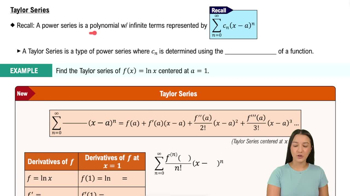
Taylor Series Expansion

A Taylor series represents a function as an infinite sum of terms calculated from the derivatives of the function at a single point. It approximates the function near that point using polynomial terms, making complex functions easier to estimate.
Video consigliato:
08:42
Taylor Series

Derivatives of Functions

Derivatives measure the rate of change of a function and are essential for finding the coefficients in a Taylor series. Calculating successive derivatives at the expansion point provides the terms needed for the polynomial approximation.
Video consigliato:
06:30
Derivatives of Other Trig Functions

Approximation Using Partial Sums

Using only the first few terms of a Taylor series (partial sums) provides an approximation of the function near the expansion point. The accuracy depends on the number of terms and the distance from the point a; here, the first four terms approximate ∛60 near a=64.
Video consigliato:
Percorso guidato
08:01
Integration Using Partial Fractions
Pratica correlata
Domanda del libro di testo

L'Hôpital's Rule by Taylor series Suppose f and g have Taylor series about the point a.

a. If f(a) = g(a) = 0 and g′(a) ≠ 0, evaluate lim ₓ→ₐ f(x)/g(x) by expanding f and g in their Taylor series. Show that the result is consistent withl’Hôpital’s Rule.

b. If f(a) = g(a) =f′(a) = g′(a) = 0 and g′′(a) ≠ 0, evaluate lim ₓ→ₐ f(x)/g(x) by expanding f and g in their Taylor series. Show that the result is consistent with two applications of 1'Hôpital's Rule.

55
views
Domanda del libro di testo

Radius and interval of convergence Determine the radius and interval of convergence of the following power series.


∑ₖ₌₁∞ (3x + 2)ᵏ/k

50
views
Domanda del libro di testo

Manipulating Taylor series Use the Taylor series in Table 11.5 to find the first four nonzero terms of the Taylor series for the following functions centered at 0.


sinh x²

79
views
Domanda del libro di testo

Differential equations


a. Find a power series for the solution of the following differential equations, subject to the given initial condition

b. Identify the function represented by the power series.


y′(t) − y = 0, y(0) = 2

69
views
Domanda del libro di testo

Remainders Find the remainder Rₙ for the nth−order Taylor polynomial centered at a for the given functions. Express the result for a general value of n.


f(x) = 1/(1 - x), a=0

72
views
Domanda del libro di testo

Working with binomial series Use properties of power series, substitution, and factoring to find the first four nonzero terms of the Maclaurin series for the following functions. Use the Maclaurin series


(1 + x)⁻² = 1 − 2x + 3x² − 4x³ + ⋯, for −1 < x < 1.


(1 + 4x)⁻²

59
views