Ch. 11 - Power Series
Briggs - Calculus: Early Transcendentals 3rd Edition
Briggs3rd EditionCalculus: Early TranscendentalsISBN: 9780136847243Non è quello che usi tu?Cambia libro di testo
Capitolo 11, Problema 11.4.79e

{Use of Tech} Fresnel integrals The theory of optics gives rise to the two Fresnel integrals
S(x) = ∫₀ˣ sin t² dt and C(x) = ∫₀ˣ cos t² dt
e. How many terms of the Maclaurin series are required to approximate C(−0.25) with an error no greater than 10⁻⁶?

Guida verificata passo dopo passo
1
Recall that the Fresnel integral \( C(x) = \int_0^x \cos(t^2) \, dt \) can be expanded into a Maclaurin series by expanding \( \cos(t^2) \) as a power series and integrating term-by-term.
Write the Maclaurin series for \( \cos(z) \), which is \( \cos(z) = \sum_{n=0}^\infty (-1)^n \frac{z^{2n}}{(2n)!} \). Substitute \( z = t^2 \) to get \( \cos(t^2) = \sum_{n=0}^\infty (-1)^n \frac{t^{4n}}{(2n)!} \).
Integrate the series term-by-term from 0 to \( x \) to find the series for \( C(x) \): \[ C(x) = \sum_{n=0}^\infty (-1)^n \frac{1}{(2n)!} \int_0^x t^{4n} \, dt = \sum_{n=0}^\infty (-1)^n \frac{x^{4n+1}}{(4n+1)(2n)!} \].
To approximate \( C(-0.25) \) with an error no greater than \( 10^{-6} \), use the alternating series remainder estimation. The error is less than or equal to the absolute value of the first omitted term in the series.
Find the smallest integer \( N \) such that the absolute value of the \( (N+1)^{th} \) term: \[ \left| (-1)^{N+1} \frac{(-0.25)^{4(N+1)+1}}{(4(N+1)+1)(2(N+1))!} \right| \leq 10^{-6} \]. This will tell you how many terms are needed to achieve the desired accuracy.

Risposta video verificata per un problema simile:

Questa soluzione video è stata consigliata dai nostri tutor come utile per risolvere questo problema.
Durata del video:
4m

Concetti chiave

Ecco i concetti essenziali che devi comprendere per rispondere correttamente alla domanda.

Fresnel Integrals

Fresnel integrals S(x) and C(x) are defined as integrals of sine and cosine functions with quadratic arguments, specifically S(x) = ∫₀ˣ sin(t²) dt and C(x) = ∫₀ˣ cos(t²) dt. They arise in optics and wave theory, representing diffraction patterns and are not expressible in elementary functions, often requiring series expansions or numerical methods for evaluation.
Video consigliato:
Percorso guidato
06:18
Integration by Parts for Definite Integrals

Maclaurin Series Expansion

A Maclaurin series is a Taylor series expansion of a function about zero, expressing it as an infinite sum of derivatives at zero multiplied by powers of x. For functions like cos(t²), the Maclaurin series allows approximation by polynomials, facilitating numerical evaluation of integrals like C(x) by integrating term-by-term.
Video consigliato:
08:26
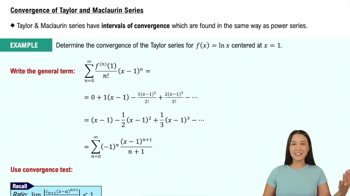
Convergence of Taylor & Maclaurin Series

Error Estimation in Series Approximation

When approximating functions with series, the error is the difference between the true value and the partial sum. To ensure the error is below a threshold (e.g., 10⁻⁶), one uses remainder estimates or bounds on the next term in the series. This guides how many terms are needed for a desired accuracy.
Video consigliato:
Percorso guidato
04:57
Determining Error and Relative Error