Ch. 11 - Power Series
Briggs - Calculus: Early Transcendentals 3rd Edition
Briggs3rd EditionCalculus: Early TranscendentalsISBN: 9780136847243Non è quello che usi tu?Cambia libro di testo
Capitolo 11, Problema 11.1.12

Use of Tech Linear and quadratic approximation


a. Find the linear approximating polynomial for the following functions centered at the given point a.


b. Find the quadratic approximating polynomial for the following functions centered at a.


c Use the polynomials obtained in parts (a) and (b) to approximate the given quantity.


f(x)=e⁻²ˣ, a=0; approximate e⁻⁰ᐧ².

Guida verificata passo dopo passo
1
Identify the function and the point of approximation: here, the function is \(f(x) = e^{-2x}\) and the center point is \(a = 0\).
Find the value of the function at \(a\): calculate \(f(0) = e^{-2 \cdot 0} = e^0 = 1\).
Compute the first derivative \(f'(x)\) and evaluate it at \(a\): since \(f(x) = e^{-2x}\), then \(f'(x) = -2 e^{-2x}\), so \(f'(0) = -2 e^0 = -2\).
For the linear approximation (first-degree Taylor polynomial) centered at \(a=0\), use the formula: \(L(x) = f(a) + f'(a)(x - a)\), which becomes \(L(x) = 1 - 2(x - 0) = 1 - 2x\).
For the quadratic approximation (second-degree Taylor polynomial), compute the second derivative \(f''(x)\) and evaluate at \(a\): \(f''(x) = 4 e^{-2x}\), so \(f''(0) = 4\). Then use the formula \(Q(x) = f(a) + f'(a)(x - a) + \frac{f''(a)}{2}(x - a)^2\), which becomes \(Q(x) = 1 - 2x + 2x^2\). Finally, substitute \(x = 0.1\) (since \(e^{-0.2} = e^{-2 \cdot 0.1}\)) into both \(L(x)\) and \(Q(x)\) to approximate \(e^{-0.2}\).

Risposta video verificata per un problema simile:

Questa soluzione video è stata consigliata dai nostri tutor come utile per risolvere questo problema.
Durata del video:
5m

Concetti chiave

Ecco i concetti essenziali che devi comprendere per rispondere correttamente alla domanda.

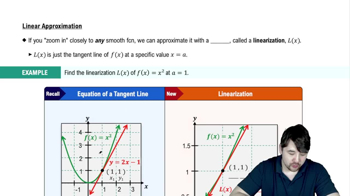
Linear Approximation (Linearization)

Linear approximation uses the tangent line at a point to estimate the value of a function near that point. It is given by L(x) = f(a) + f'(a)(x - a), where f'(a) is the derivative at a. This method simplifies complex functions to linear polynomials for easier calculation of nearby values.
Video consigliato:

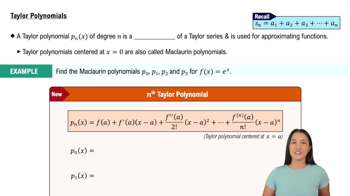
Quadratic Approximation (Second-Order Taylor Polynomial)

Quadratic approximation extends linearization by including the second derivative, providing a better estimate near the point a. It is expressed as Q(x) = f(a) + f'(a)(x - a) + (f''(a)/2)(x - a)^2, capturing curvature to improve accuracy over linear approximation.
Video consigliato:
07:00
Taylor Polynomials

Using Approximations to Estimate Function Values

Once linear and quadratic polynomials are found, they can approximate function values at points close to a. This avoids complex calculations of the original function, especially for transcendental functions like e^(-2x), by substituting x into the simpler polynomial forms.
Video consigliato:
Percorso guidato
07:59
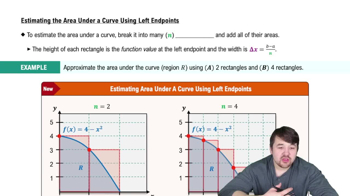
Estimating the Area Under a Curve Using Left Endpoints