Ch. 11 - Power Series
Briggs - Calculus: Early Transcendentals 3rd Edition
Briggs3rd EditionCalculus: Early TranscendentalsISBN: 9780136847243Non è quello che usi tu?Cambia libro di testo
Capitolo 11, Problema 11.1.73b

{Use of Tech} Small argument approximations Consider the following common approximations when x is near zero. 


b. Estimate f(0.2) and give a bound on the error in the approximation.


f(x) =√(1+x) ≈ 1 + x/2

Guida verificata passo dopo passo
1
Identify the function and its approximation: The function given is \(f(x) = \sqrt{1+x}\), and the approximation near \(x=0\) is \(f(x) \approx 1 + \frac{x}{2}\).
Calculate the approximate value at \(x=0.2\) using the linear approximation: Substitute \(x=0.2\) into the approximation to get \(f(0.2) \approx 1 + \frac{0.2}{2}\).
Understand the error bound concept: The error in the approximation can be estimated using the remainder term from Taylor's theorem, which involves the second derivative of \(f(x)\).
Find the second derivative of \(f(x)\): First, compute \(f'(x) = \frac{1}{2\sqrt{1+x}}\), then find \(f''(x) = -\frac{1}{4(1+x)^{3/2}}\).
Use the error bound formula for the linear approximation: The error \(R_2\) satisfies \(|R_2| \leq \frac{M}{2} |x|^2\), where \(M\) is the maximum value of \(|f''(x)|\) on the interval between 0 and 0.2. Determine \(M\) and calculate the bound.

Risposta video verificata per un problema simile:

Questa soluzione video è stata consigliata dai nostri tutor come utile per risolvere questo problema.
Durata del video:
4m

Concetti chiave

Ecco i concetti essenziali che devi comprendere per rispondere correttamente alla domanda.

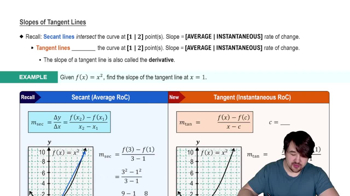
Linear Approximation (Tangent Line Approximation)

Linear approximation uses the tangent line at a point to estimate function values near that point. For f(x) near x=0, f(x) ≈ f(0) + f'(0)(x - 0). Here, √(1+x) is approximated by 1 + x/2, which is the tangent line at x=0.
Video consigliato:
Percorso guidato
05:13
Slopes of Tangent Lines

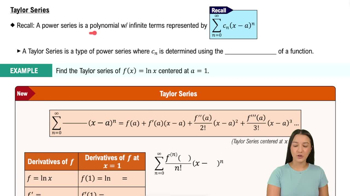
Error Bound Using the Remainder Term in Taylor's Theorem

The error bound estimates how far the approximation is from the true value. Using Taylor's theorem, the remainder term involves higher derivatives evaluated at some point between 0 and x, providing a maximum possible error for the approximation.
Video consigliato:
08:42
Taylor Series

Derivative of the Square Root Function

Understanding the derivative of f(x) = √(1+x) is essential for both approximation and error estimation. The first derivative is f'(x) = 1/(2√(1+x)), which determines the slope of the tangent line used in the linear approximation.
Video consigliato: