Ch. 2 - Limits
Briggs - Calculus: Early Transcendentals 3rd Edition
Briggs3rd EditionCalculus: Early TranscendentalsISBN: 9780136847243Non è quello che usi tu?Cambia libro di testo
Capitolo 2, Problema 7

Assume lim x→1 f(x)=8,lim x→1 g(x)=3, and lim x→1 h(x)=2 Compute the following limits and state the limit laws used to justify your computations.


lim x→1 (4f(x))

Guida verificata passo dopo passo
1
Identify the given limit: \( \lim_{{x \to 1}} f(x) = 8 \).
Recognize that the problem involves a constant multiple of a function: \( 4f(x) \).
Apply the Constant Multiple Law for limits, which states that \( \lim_{{x \to a}} [c \cdot f(x)] = c \cdot \lim_{{x \to a}} f(x) \), where \( c \) is a constant.
Substitute the given limit into the Constant Multiple Law: \( 4 \cdot \lim_{{x \to 1}} f(x) = 4 \cdot 8 \).
Conclude that the limit is \( 4 \cdot 8 \), but do not calculate the final result.

Risposta video verificata per un problema simile:

Questa soluzione video è stata consigliata dai nostri tutor come utile per risolvere questo problema.
Durata del video:
2m

Concetti chiave

Ecco i concetti essenziali che devi comprendere per rispondere correttamente alla domanda.

Limit of a Function

The limit of a function describes the value that the function approaches as the input approaches a certain point. In this case, as x approaches 1, the limits of f(x), g(x), and h(x) are given, which are essential for evaluating expressions involving these functions. Understanding limits is fundamental in calculus as it lays the groundwork for continuity, derivatives, and integrals.
Video consigliato:
06:11
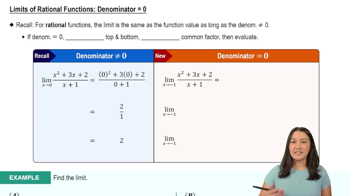
Limits of Rational Functions: Denominator = 0

Limit Laws

Limit laws are a set of rules that allow us to compute limits of functions based on the limits of their components. For example, one important limit law states that the limit of a constant multiplied by a function is the constant multiplied by the limit of the function. This principle is crucial for simplifying the computation of limits, such as lim x→1 (4f(x)), which can be evaluated using the known limit of f(x).
Video consigliato:
05:50
One-Sided Limits

Constant Multiple Rule

The Constant Multiple Rule is a specific limit law that states if c is a constant and f(x) is a function, then lim x→a (c * f(x)) = c * lim x→a f(x). This rule allows us to factor out constants when calculating limits, making it easier to find the limit of expressions like 4f(x) as x approaches 1, where we can directly multiply the limit of f(x) by 4.
Video consigliato:
04:02
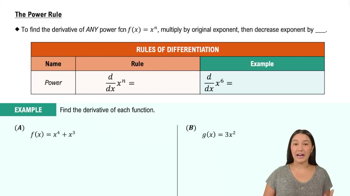
The Power Rule