Ch. 2 - Limits
Briggs - Calculus: Early Transcendentals 3rd Edition
Briggs3rd EditionCalculus: Early TranscendentalsISBN: 9780136847243Non è quello che usi tu?Cambia libro di testo
Capitolo 2, Problema 18

Determine the following limits. 
lim t→∞ (5t2 + t sin t) / t2

Guida verificata passo dopo passo
1
Identify the dominant terms in the numerator and the denominator. In this case, the dominant term in the numerator is \$5t^2$ and in the denominator is $t^2$.
Divide every term in the numerator and the denominator by \(t^2\) to simplify the expression.
The expression becomes \(\frac{5t^2}{t^2} + \frac{t \sin t}{t^2}\) in the numerator and \(\frac{t^2}{t^2}\) in the denominator.
Simplify the expression to \(5 + \frac{\sin t}{t}\).
Evaluate the limit as \(t \to \infty\). The term \(\frac{\sin t}{t}\) approaches 0 as \(t\) becomes very large, so the limit is determined by the constant term 5.

Risposta video verificata per un problema simile:

Questa soluzione video è stata consigliata dai nostri tutor come utile per risolvere questo problema.
Durata del video:
5m

Concetti chiave

Ecco i concetti essenziali che devi comprendere per rispondere correttamente alla domanda.

Limits at Infinity

Limits at infinity involve evaluating the behavior of a function as the variable approaches infinity. This concept is crucial for understanding how functions behave for very large values, which often simplifies the analysis of rational functions and helps determine horizontal asymptotes.
Video consigliato:
05:50
One-Sided Limits

Dominant Terms

In the context of limits, dominant terms are the terms in a polynomial or rational function that have the greatest impact on the function's value as the variable approaches infinity. Identifying these terms allows for simplification of the limit, as lower-order terms become negligible compared to the dominant ones.
Video consigliato:
2:02
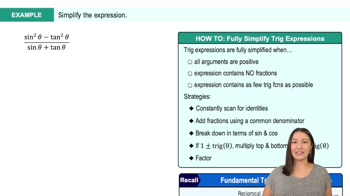
Simplifying Trig Expressions Example 1

L'Hôpital's Rule

L'Hôpital's Rule is a method used to evaluate limits that result in indeterminate forms, such as 0/0 or ∞/∞. By differentiating the numerator and denominator separately, this rule can simplify the limit calculation, making it easier to find the limit's value as the variable approaches a specific point or infinity.
Video consigliato:
5:50
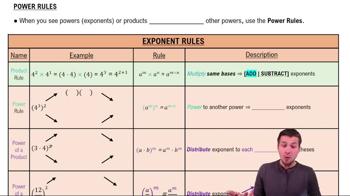
Power Rules