Ch. 2 - Limits
Briggs - Calculus: Early Transcendentals 3rd Edition
Briggs3rd EditionCalculus: Early TranscendentalsISBN: 9780136847243Non è quello che usi tu?Cambia libro di testo
Capitolo 2, Problema 2.5.7

Determine the following limits at infinity.


lim t→∞ (−12t^−5)

Guida verificata passo dopo passo
1
Identify the expression: \(-12t^{-5}\).
Recognize that as \(t\) approaches infinity, the term \(t^{-5}\) represents \(\frac{1}{t^5}\).
Understand that \(\frac{1}{t^5}\) approaches 0 as \(t\) approaches infinity because the denominator grows very large.
Multiply the limit of \(t^{-5}\) by \(-12\), which is a constant, to find the limit of the entire expression.
Conclude that the limit of \(-12t^{-5}\) as \(t\) approaches infinity is 0.

Risposta video verificata per un problema simile:

Questa soluzione video è stata consigliata dai nostri tutor come utile per risolvere questo problema.
Durata del video:
4m

Concetti chiave

Ecco i concetti essenziali che devi comprendere per rispondere correttamente alla domanda.

Limits at Infinity

Limits at infinity refer to the behavior of a function as the input approaches infinity. This concept is crucial in calculus for understanding how functions behave in extreme cases, particularly for rational functions, polynomials, and exponential functions. Evaluating limits at infinity helps determine horizontal asymptotes and the end behavior of functions.
Video consigliato:
05:50
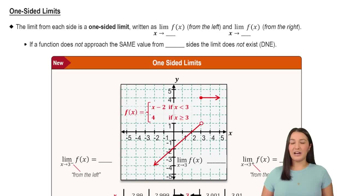
One-Sided Limits

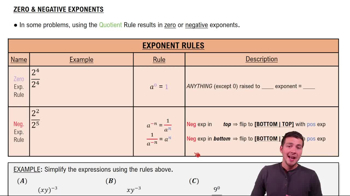
Negative Exponents

Negative exponents indicate the reciprocal of the base raised to the corresponding positive exponent. For example, t^−5 is equivalent to 1/t^5. Understanding negative exponents is essential for simplifying expressions and evaluating limits, especially as the variable approaches infinity, where terms with negative exponents tend to zero.
Video consigliato:
6:37
Zero and Negative Rules

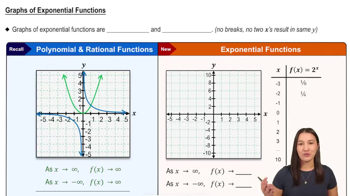
Behavior of Functions as t Approaches Infinity

The behavior of functions as t approaches infinity involves analyzing how the function's value changes as t increases without bound. In the case of polynomial functions with negative exponents, the function's value will approach zero. This concept is vital for determining the limit of functions at infinity and understanding their long-term trends.
Video consigliato:
5:46
Graphs of Exponential Functions