Ch. 2 - Limits
Briggs - Calculus: Early Transcendentals 3rd Edition
Briggs3rd EditionCalculus: Early TranscendentalsISBN: 9780136847243Non è quello che usi tu?Cambia libro di testo
Capitolo 2, Problema 13

Determine the following limits.
lim h→0 (h + 6)^2 + (h + 6) − 42 / h

Guida verificata passo dopo passo
1
Step 1: Identify the expression whose limit we need to find. The expression is \( \frac{(h + 6)^2 + (h + 6) - 42}{h} \).
Step 2: Simplify the numerator. Expand \((h + 6)^2\) to get \(h^2 + 12h + 36\).
Step 3: Combine the terms in the numerator. The expression becomes \(h^2 + 12h + 36 + h + 6 - 42\).
Step 4: Simplify the combined terms. This results in \(h^2 + 13h\).
Step 5: Factor the numerator. The expression \(h^2 + 13h\) can be factored as \(h(h + 13)\).

Risposta video verificata per un problema simile:

Questa soluzione video è stata consigliata dai nostri tutor come utile per risolvere questo problema.
Durata del video:
3m

Concetti chiave

Ecco i concetti essenziali che devi comprendere per rispondere correttamente alla domanda.

Limits

Limits are fundamental in calculus, representing the value that a function approaches as the input approaches a certain point. They are essential for understanding continuity, derivatives, and integrals. In this question, evaluating the limit as h approaches 0 helps determine the behavior of the function near that point.
Video consigliato:
05:50
One-Sided Limits

Algebraic Manipulation

Algebraic manipulation involves rearranging and simplifying expressions to make calculations easier. In the context of limits, it often includes factoring, expanding, or combining like terms to eliminate indeterminate forms such as 0/0. This skill is crucial for simplifying the expression before applying limit laws.
Video consigliato:
05:25
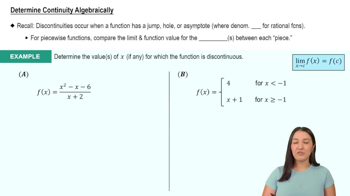
Determine Continuity Algebraically

L'Hôpital's Rule

L'Hôpital's Rule is a method used to evaluate limits that result in indeterminate forms like 0/0 or ∞/∞. It states that if such a form occurs, the limit of the ratio of two functions can be found by taking the derivative of the numerator and the derivative of the denominator. This rule can simplify the process of finding limits in complex expressions.
Video consigliato:
5:50
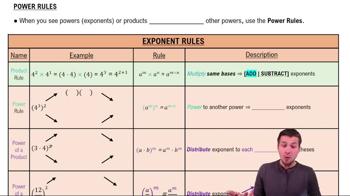
Power Rules
Pratica correlata
Domanda del libro di testo

The position of an object moving vertically along a line is given by the function s(t)=−16t2+128ts\(\left\)(t\(\right\))=-16t^2+128t. Find the average velocity of the object over the following intervals.

[1,4]\(\left\[\lbrack\)1,4\(\right\]\rbrack\)

378
views
Domanda del libro di testo

Determine the following limits.

lim x→a (3x + 1)^2 − (3a + 1)^2 / x − a, where a is constant

348
views
Domanda del libro di testo

Graph the function f(x)=e^−x / x(x+2)^2 using a graphing utility. (Experiment with your choice of a graphing window.) Use your graph to determine the following limits.


c. lim x→0^− f(x)

275
views
Domanda del libro di testo

Graph the function f(x)=e^−x / x(x+2)^2 using a graphing utility. (Experiment with your choice of a graphing window.) Use your graph to determine the following limits.


d. lim x→0^+ f(x)

296
views
Domanda del libro di testo

The position of an object moving vertically along a line is given by the function s(t)=−16t2+128ts\(\left\)(t\(\right\))=-16t^2+128t. Find the average velocity of the object over the following intervals.

[1,2]\(\left\[\lbrack\)1,2\(\right\]\rbrack\)

397
views
Domanda del libro di testo

Given the function f(x)=−16x2+64xf\(\left\)(x\(\right\))=-16x^2+64x, complete the following. <IMAGE>

Make a conjecture about the value of the limit of the slopes of the secant lines that pass through (x,f(x))\(\left\)(x,f\(\left\)(x\(\right\))\(\right\)) and (2,f(2))\(\left\)(2,f\(\left\)(2\(\right\))\(\right\)) as xx approaches 22.

319
views