Ch. 2 - Limits
Briggs - Calculus: Early Transcendentals 3rd Edition
Briggs3rd EditionCalculus: Early TranscendentalsISBN: 9780136847243Non è quello che usi tu?Cambia libro di testo
Capitolo 2, Problema 21

Determine the following limits.
lim x→3 x^4 − 81 / x − 3

Guida verificata passo dopo passo
1
Identify the form of the limit: Substitute \( x = 3 \) into the expression \( \frac{x^4 - 81}{x - 3} \) to see if it results in an indeterminate form like \( \frac{0}{0} \).
Recognize that \( x^4 - 81 \) can be factored as a difference of squares: \( x^4 - 81 = (x^2 - 9)(x^2 + 9) \).
Further factor \( x^2 - 9 \) as a difference of squares: \( x^2 - 9 = (x - 3)(x + 3) \).
Rewrite the original expression using the factored form: \( \frac{(x - 3)(x + 3)(x^2 + 9)}{x - 3} \).
Cancel the common factor \( x - 3 \) in the numerator and denominator, then evaluate the limit of the simplified expression as \( x \to 3 \).

Risposta video verificata per un problema simile:

Questa soluzione video è stata consigliata dai nostri tutor come utile per risolvere questo problema.
Durata del video:
5m

Concetti chiave

Ecco i concetti essenziali che devi comprendere per rispondere correttamente alla domanda.

Limits

A limit is a fundamental concept in calculus that describes the behavior of a function as its input approaches a certain value. It helps in understanding how functions behave near points of interest, including points where they may not be defined. In this case, we are interested in the limit as x approaches 3, which requires evaluating the function's behavior close to that point.
Video consigliato:
05:50
One-Sided Limits

Factoring Polynomials

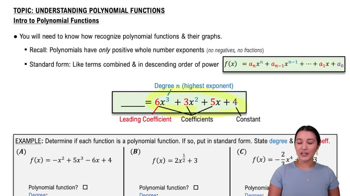
Factoring polynomials is the process of breaking down a polynomial into simpler components, or factors, that can be multiplied together to yield the original polynomial. In the given limit, the expression x^4 - 81 can be factored using the difference of squares, which simplifies the limit calculation by eliminating the indeterminate form that occurs when directly substituting x = 3.
Video consigliato:
6:04
Introduction to Polynomial Functions

Indeterminate Forms

Indeterminate forms arise in calculus when direct substitution in a limit leads to an undefined expression, such as 0/0 or ∞/∞. In this problem, substituting x = 3 into the limit results in the form 0/0, indicating that further analysis, such as factoring or applying L'Hôpital's Rule, is necessary to resolve the limit and find a meaningful value.
Video consigliato:
3:56
Slope-Intercept Form